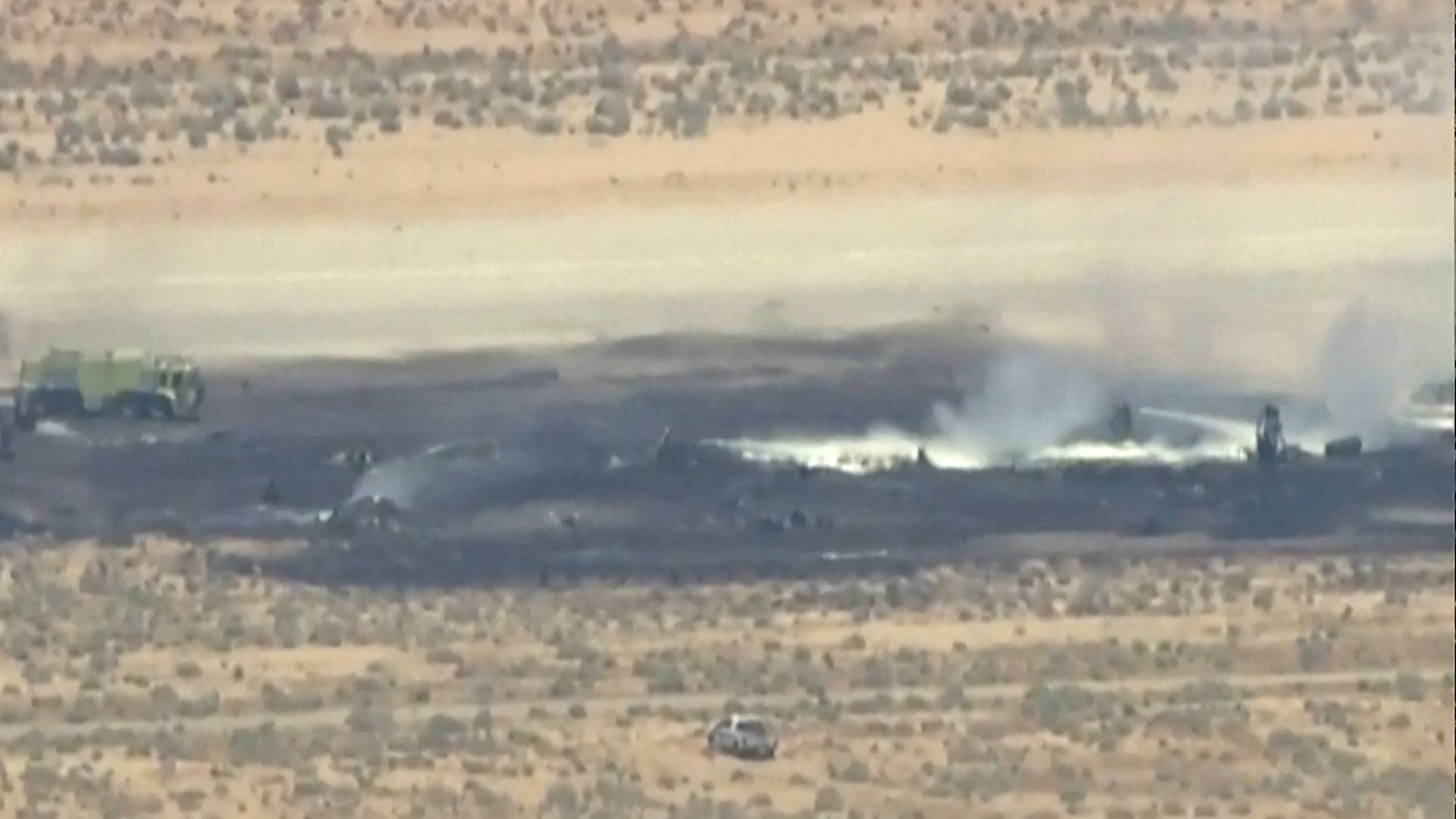
A routine Monday morning test mission turned into one of the worst military aviation disasters in recent memory when a B-52 Stratofortress plunged into the California desert. Eight people are dead. The wreckage at Edwards Air Force Base is so severe that aerial footage shows virtually nothing left of the massive eight-engine bomber.
The crash happened at 11:20 a.m. local time, just seconds after the heavy bomber lifted off the runway. It didn't gain much altitude. It didn't get very far from the airfield. Instead, it came down hard, igniting a massive fireball that sent thick, black smoke billowing over the Mojave Desert. Air Force officials quickly realized the magnitude of the tragedy, stating openly that the impact was completely unsurvivable.
What Happened at Edwards Air Force Base
The base closed its airfield immediately, diverted all inbound flights, and locked down visitor access. James Hayes, the Deputy Commander at Edwards, confirmed the total loss of life during a somber news conference. "We lost eight great Americans," Hayes stated, noting that an interim safety board has already been established to gather facts. The full investigation will likely take up to six months.
People are asking why eight people were on board when a standard B-52 crew consists of five airmen. This flight was a specialized test mission. Edwards Air Force Base is famous for being the site where Chuck Yeager first broke the sound barrier in 1947. It remains the premier testing ground for new military technology. During test flights, aircraft frequently carry extra engineers, technicians, and system specialists to monitor experimental equipment in real time.
The military hasn't disclosed whether the bomber carried any weapons. However, given that this was a test flight originating from a premier flight-test installation, it is highly unlikely live ordnance was on board.
Early Clues Point to Control Problems
The aviation community is already looking closely at how the giant plane came down. The fact that the B-52 crashed so quickly after takeoff points toward a catastrophic mechanical or structural issue.
Jeff Guzzetti, a seasoned accident investigator who previously led teams for both the Federal Aviation Administration (FAA) and the National Transportation Safety Board (NTSB), shared his initial assessment. He suspects a major controllability issue caused the disaster.
According to Guzzetti, a few specific scenarios usually cause a massive aircraft to fail right after takeoff:
- Flight Control Malfunction: The mechanical linkages or hydraulic systems that move the flaps, rudders, or elevators could have jammed or failed.
- Incorrect Maintenance Rigging: If flight controls were recently serviced, a catastrophic error in how they were reconnected could make the plane impossible to fly.
- Experimental Equipment Failure: Since the plane was on a test mission, a failure in whatever new system they were evaluating could have interfered with the aircraft's aerodynamics or power plants.
- Catastrophic Engine Failure: While the B-52 has eight engines, losing multiple engines on one side simultaneously during a critical takeoff phase can cause an unrecoverable asymmetric thrust condition.
Testing new hardware on an old airframe is inherently dangerous. Air Force test pilots are among the best in the world, but if a plane loses its physical capability to be controlled, pilot skill cannot save it.
The Aging Fleet Dilemma
The Boeing B-52 Stratofortress is a legendary machine, but it is also an incredibly old one. The aircraft first entered active service in 1955. The specific models flying today, the B-52H variants, were built in the early 1960s. That means the youngest B-52 in the sky is over 60 years old.
The Air Force keeps these cold-war icons flying because they are incredibly reliable trucks for delivering heavy payloads. The Pentagon even plans to keep them operational beyond 2050 through massive upgrade programs, which include fitting them with brand-new Rolls-Royce engines and modern radar systems.
This tragic event raises serious questions about the stress we are putting on these ancient airframes during aggressive modernization testing. When you pack cutting-edge digital tech and new mechanical systems into a fuselage manufactured during the Kennedy administration, you run into unpredictable engineering hurdles.
Next Steps for Aviation Observers
If you are tracking this story, don't expect instant answers. Military accident investigations are notoriously slow and meticulous. Over the coming weeks, look for updates from the Air Force Safety Center regarding the composition of the official Mishap Investigation Board. Investigators will focus heavily on pulling data from the flight data recorders and analyzing the maintenance logs from the days leading up to the flight.