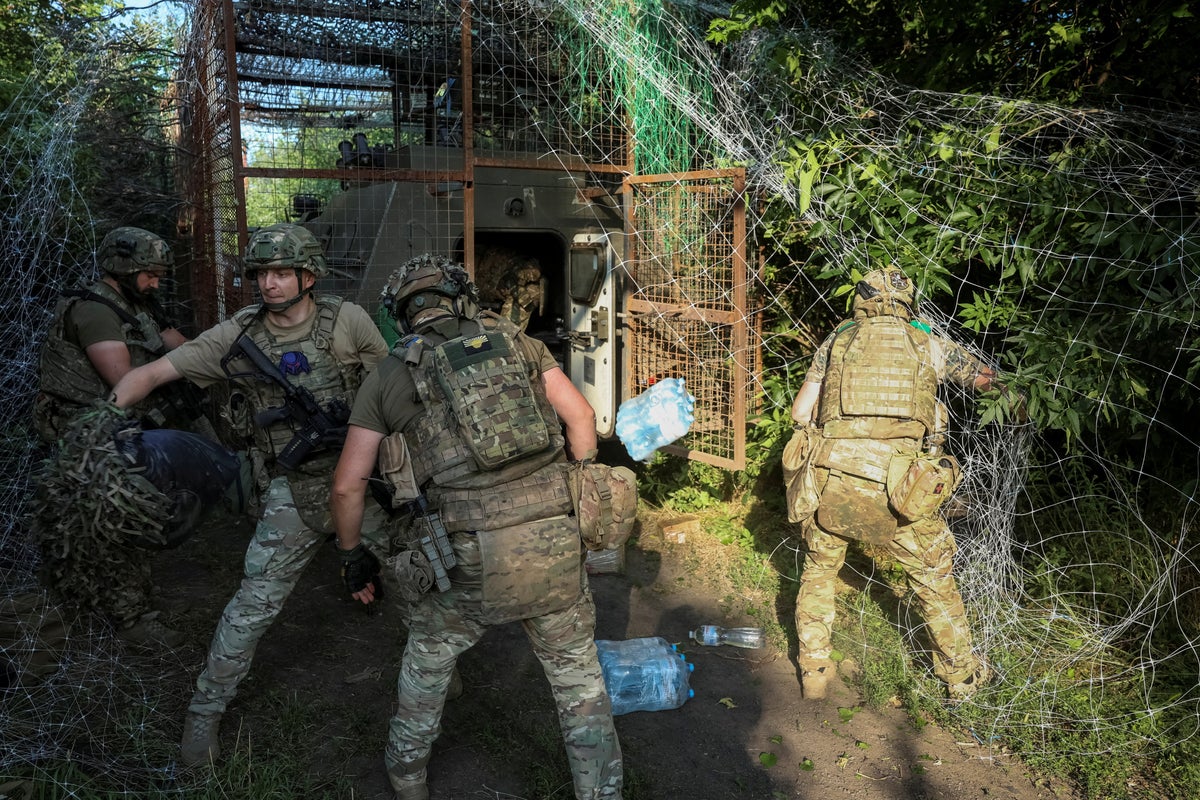
Vladimir Putin wants you to think the war in the east is already decided. He recently claimed his forces control Kostiantynivka, a critical industrial hub in Ukraine's eastern Donetsk region. That's not true—at least not yet. But the reality on the ground is grim enough without the Kremlin's spin. Russian troops have breached the city limits, sparking brutal urban warfare that directly threatens the backbone of Ukraine’s remaining defenses in the Donbas.
If you want to understand why this matters, look at a map of eastern Ukraine. Kostiantynivka is the southern anchor of the "fortress belt"—a heavily fortified network of four cities including Druzhkivka, Kramatorsk, and Sloviansk. For years, this belt has stood as an unbreakable wall against Russian ambitions. Now, that wall is cracking.
The battle has transitioned from a series of peripheral skirmishes into a desperate fight for the city center. Russia has turned Kostiantynivka into its top tactical priority for the summer. If it falls, the gateway to the rest of the Donetsk region swings wide open.
Anatomy of the fortress belt
To see why the Ukrainian high command is sweating over this city, you have to look at how the regional defense is built. The fortress belt isn't just a collection of trenches. It is a dense, interconnected industrial urban sprawl.
Kostiantynivka historically served as a major transit railway junction and a heavy manufacturing hub known for iron foundries, zinc smelting, and glass production. Its industrial zones—like the sprawling Ukrtsink plant—are built from reinforced concrete and steel, making them ready-made fortresses.
[Sloviansk] -> [Kramatorsk] -> [Druzhkivka] -> [Kostiantynivka]
   (North)                                         (South Anchor)
The cities are lined up linearly along a main northern highway and rail line. Kostiantynivka sits right at the southern tip, directly facing the Russian advance following the fall of Toretsk. It acts as a shield. As long as Ukrainian forces hold it, Russian artillery can't easily ground down Druzhkivka or the administrative hub of Kramatorsk. If Russia punches through the southern anchor, they don't just win a city; they get a straight shot north to roll up the entire defensive line from the flank.
How the infiltration turned into an onslaught
Russia didn't capture this city with a massive, grand armor charge. They did it by seeping through the cracks.
The strategy mirrors what happened in Pokrovsk. It starts with small infiltration teams—sometimes just two or three infantrymen—creeping through tree lines, gullies, and abandoned suburban homes under the cover of electronic warfare. Initially, Ukrainian drone teams could spot and eliminate these tiny groups. But Russia keeps sending them. It's a relentless human conveyor belt.
By early summer, those tiny trickles achieved critical mass. Local commanders admitted that over 250 Russian soldiers had successfully embedded themselves inside urban neighborhoods, reaching deep enough to spark fights around the central zinc plant. Ukrainian brigades find themselves fighting interspersed battles where the frontline isn't a clean line on a map, but a chaotic checkerboard of occupied buildings.
The situation worsened dramatically when Russia deployed specialized drone units, like the "Rubicon" Center for Advanced Unmanned Technologies, to the sector. This specialized electronic and drone pressure has severely disrupted Ukrainian logistics. The roads leading into the city are now highly dangerous paths where resupply vehicles and medical evacuations must run a gauntlet of hostile FPV drones.
The structural crisis facing Ukraine
The crisis in Kostiantynivka exposes the structural issues plaguing Ukraine's defense, even as Kyiv successfully strikes Russian refineries and naval targets elsewhere.
- The Manpower Deficit: The 24th and 28th Mechanized Brigades holding the area are incredibly overstretched. Soldiers are exhausted, and rotations are tough to execute safely under constant drone surveillance. Drones can drop bombs, but they cannot physically hold a basement or clear a trench line; you still need boots on the ground to do that.
- Semi-Encirclemet Tactics: Russia isn't just pushing into the eastern suburbs. They are advancing on the villages of Novodmytrivka and cutting toward the western outskirts, threatening to squeeze the city into a pocket. The 28th Mechanized Brigade has already warned that tactical Russian gains have left defenders in a partial trap.
- High-Attrition Warfare: Make no mistake, Russia is paying a staggering price in blood and equipment for every block they take. But the Kremlin has repeatedly shown it's entirely willing to trade thousands of lives for a few square kilometers of ruined industrial terrain.
What happens next
Unless the Ukrainian military can find the fresh reserves to mount a successful counter-attack and clear the domestic breaches very soon, the battle for the city center will reach a bloody climax by the end of summer. We aren't likely to see a clean, dramatic encirclement. Instead, expect a grinding war of attrition followed by a risky, step-by-step Ukrainian withdrawal under fire, much like the bitter conclusions seen in Avdiivka and Pokrovsk.
If Kostiantynivka falls completely, your attention must immediately shift to Druzhkivka and the Kramatorsk twin-city hubs. Ukraine's international partners recently helped secure a $30 billion boost to its defense budget, pushing the 2026 total to nearly $98 billion. That money needs to translate into immediate physical fortifying of the next defensive lines further north. If you're tracking this conflict, keep your eyes on the H-20 highway and the northern defensive works. The fight for the Donbas is reaching its most dangerous phase, and the buffer zone is completely gone.