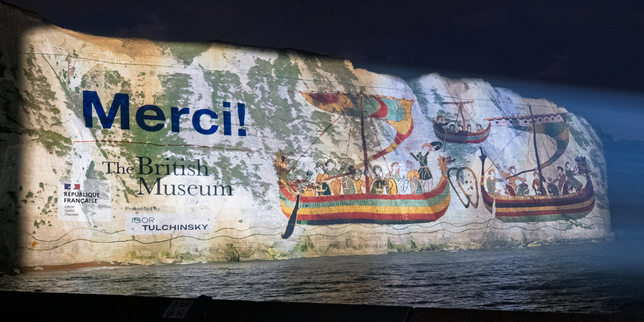
France is sending its most famous medieval treasure across the English Channel. It is official. The historic 11th-century embroidered cloth that charts the Norman Conquest of England is heading to the British Museum.
For decades, experts said this would never happen. The artifact is too fragile. The politics are too messy. The historical wounds, even those from 1066, apparently still linger just beneath the surface of European diplomacy. Yet here we are. This massive gesture of cultural sharing represents something far deeper than a simple museum exchange. It is a calculated, high-stakes display of trust between two nations navigating a complicated modern relationship. For another view, read: this related article.
If you think this is just about old linen and wool thread, you are missing the entire point.
Moving a Nine Hundred Year Old Masterpiece Across the Channel
The logistics alone are terrifying. We are talking about a piece of embroidered linen that stretches nearly 70 meters long. It has survived fires, wars, the French Revolution, and Nazi attempts to seize it during World War II. It normally sits under highly controlled lighting and climate conditions in Normandy. Related analysis on this matter has been shared by Al Jazeera.
Moving it requires military-grade precision. Curators have spent years studying the structural integrity of the fabric. Every single stitch of wool yarn, dyed centuries ago with woad, madder, and weld, must be stabilized. The backing cloth requires reinforcement.
Many people do not realize how close this piece came to never leaving France. Traditionalists argued that transport could cause irreparable creasing. The fibers are stiff with age. A single sudden shift in humidity could trigger microscopic tearing across the scenes of the Battle of Hastings.
The decision to proceed proves that political intent has overridden conservation anxieties. This loan serves as a literal and figurative bridge. It reminds everyone that British and French histories are completely inseparable, bound by blood, conquest, and shared culture since the Middle Ages.
The Logistics of Shifting Medieval Fabric
Think about what it takes to pack a 230-foot long textile. You cannot just fold it up and throw it in a box. It requires specialized rolling drums designed to prevent friction. The transport vehicles must feature advanced shock absorption systems to handle road vibrations between Bayeux and London.
Scientists from both sides of the Channel have collaborated to map out the environmental conditions of the entire journey. The British Museum had to upgrade its own gallery spaces to match the strict preservation metrics enforced in France.
- Constant temperature control at exactly 19 degrees Celsius.
- Relative humidity locked between 50 percent and 55 percent.
- Specialized glass cases that eliminate ultraviolet light damage.
This level of scientific cooperation shows how far museum technology has come. It also reveals the sheer amount of money and effort both governments are willing to pour into this initiative. They want the public to see this as a triumph of unity.
Why This Diplomatic Move Hits Different Today
Cross-Channel relations have been rocky for years. Between trade disputes, fishing rights disagreements, and defense arguments, Paris and London frequently find themselves at odds. That is exactly why this loan is happening now.
When diplomatic channels get blocked by modern bureaucracy, culture steps in to do the heavy lifting. By lending this depiction of the Norman Conquest to the British Museum, France is making a bold statement. It is a display of ultimate confidence. They are trusting their neighbors with an irreplaceable part of French national heritage.
The irony is thick here. The embroidery itself depicts a French invasion and subjugation of England. It shows Harold Godwinson taking an arrow to the eye and William the Conqueror claiming the English throne. For centuries, it was viewed as a monument to Norman triumph over Anglo-Saxon identity. Bringing it to London transforms an ancient symbol of defeat into a modern token of partnership.
Historians have pointed out that the artifact might actually have been created in England anyway. Many scholars believe Anglo-Saxon needleworkers in Kent produced the piece under the orders of Bishop Odo of Bayeux. If true, this loan is not just a visit. It is a homecoming.
How to See the Historical Wonder
If you plan to see this historic display at the British Museum, you need to prepare well in advance. This will easily be one of the most heavily attended exhibitions of the decade.
Do not expect to just walk up to the ticket counter on a weekend afternoon. The museum will implement strict timed-entry slots to control crowd density and keep the gallery environment stable.
Your best bet is to sign up for museum membership alerts immediately. Members usually get early access to booking windows before tickets go on sale to the general public. Plan for a mid-week morning slot if you actually want to see the details of the 58 distinct scenes without staring at the back of someone else's head.
Take your time when you get there. Look closely at the borders. While the main narrative focuses on kings, knights, and battles, the top and bottom margins are filled with fables, farming scenes, and bizarre mythical beasts. That is where the real medieval world hides.
Get your travel plans to London sorted out months before the official opening date. Book your accommodation near the Bloomsbury district to avoid commuting hassles on the day of your viewing. Keep an eye on official museum announcements for exact calendar dates and ticket release windows. This exhibition will not be extended, and you will not get a second chance to see it on British soil in your lifetime.