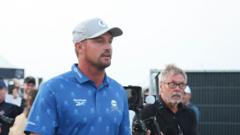
Bryson DeChambeau doesn't do quiet exits. If he's going down, he's bringing the entire rulebook, a couple of tournament directors, and the late-night media along for the ride.
What happened at Royal Southport on Friday evening wasn't just a technical infraction during the second round of the 154th Open Championship. It was theater. It was a multi-hour standoff under a darkening British sky that perfectly encapsulates why DeChambeau remains the most polarizing, fascinating figure in modern golf. Also making waves in related news: Why Lucas Herbert Stunned The Golf World And Why 61 Still Eludes Us.
The bare facts are simple enough. DeChambeau signed what he thought was a brilliant 66, leaving him a mere shot behind leader Lucas Herbert. Then the R&A stepped in. Following an intense review process that stretched long after most players had headed back to their rentals, officials smacked the 32-year-old American with a brutal two-stroke penalty. His 66 became a 68. His position fell from solo second to a tie for fifth.
But it's the chaotic sequence of events that followed which proves that nobody creates an institutional crisis quite like Bryson. Further details into this topic are explored by Yahoo Sports.
The Midnight Standoff at Royal Birkdale
The drama started on the short, 321-yard par-four fifth hole. DeChambeau launched an aggressive drive that flew way right, burying itself deep in the brutal, native sand dunes and thick marram grass. It was so far off-line that he actually played a provisional ball. When spotters miraculously located his original ball, DeChambeau spent considerable time pacing around the area, figuring out his angles and hacking a recovery shot over the back of the green, eventually saving a standard bogey.
Or so he thought.
Video footage caught the attention of the tournament committee. The R&A rules staff, led by executive director Grant Moir, decided that DeChambeau had stomped around the heavy cover a little too aggressively. Under the strict letters of Rule 8.1a, players cannot improve the area of their intended swing or lie.
Bryson exploded. He refused to accept the ruling quietly in the scoring shed. Instead, he insisted on dragging Moir and other senior officials all the way back out to the fifth hole in the fading twilight. He stood in the rough, club in hand, attempting to recreate his exact physical movements to prove he was merely trying to figure out his stance rather than intentionally modifying the turf.
By 9 PM, chief executive Mark Darbon joined the fray. The discussions grew increasingly heated. Witnesses reported hearing DeChambeau tell the suits that he wouldn't even bother showing up for his Saturday tee time. His agent, Brett Falkoff, echoed that deep frustration to the media, stating that they would evaluate their options in the morning.
Then came the peak Bryson moment. At 10 PM, wrapped in total darkness on the Birkdale range, he was still pounding balls into the night. He turned to the lingering sports writers and casually asked if anyone wanted some of his snacks before shouting out questions about his own swing mechanics. It was bizarre. It was classic Bryson.
Understanding the Fine Print of Rule 8.1a
You can understand why a player gets furious about this specific rule, but the R&A made the correct, cold call. Rule 8.1a governs what a player can and cannot do to alter the physical conditions affecting a stroke.
The rule gives you a right to fairly take your stance. It does not give you a right to a comfortable or normal swing if your ball is sitting in a horrible place.
When you find your ball in native links rough, you are allowed to walk into the grass and plant your feet. What you cannot do is pace heavily behind the ball in a way that flattens out the growth directly along the path where your club head needs to travel. The R&A statement was clear. They admitted DeChambeau’s actions were accidental. He wasn't trying to cheat. But the rules explicitly state that intent does not matter. If you flatten the grass behind the ball and make your swing path cleaner, you get penalized.
The governing bodies require players to use the "least intrusive course of action" to get to their ball. Stomping around to look at the lie from multiple angles while flattening the immediate surroundings violates that philosophical threshold.
How This Completely Changes the Open Leaderboard
This isn't just a minor technical talking point. It completely upends the competitive dynamics of the weekend.
Before the penalty, DeChambeau was the clear, looming threat to the field. He had bounced back from a vocal, pre-tournament strategic spat with golf icon Nick Faldo. He proved his aggressive, high-spin ball flight could tame Birkdale. He looked poised to steamroll into the final groups.
Now, the top of the board has a very different complexion.
- Lucas Herbert (-8): The Australian played a sublime, historic round of 62 to seize control of the tournament. He even had a putt for a 61 that barely slipped past the cup. He sits in the driver's seat.
- Sam Burns (-5): Matches Herbert's brilliance with a spectacular 62 of his own, leaping into serious contention.
- The Logjam at Four Under: Superstars like Jon Rahm, Scottie Scheffler, and Tommy Fleetwood are sitting right there at minus four, perfectly positioned to strike.
Bryson sits at five under instead of seven under. That is a massive psychological and mathematical mountain to climb in a major championship. Instead of forcing Herbert to look over his shoulder at a rampaging DeChambeau, Bryson is now mixed into the pack with the world's elite.
What Everyday Golfers Can Learn From This Drama
Most amateur players break Rule 8.1a every single Saturday without even realizing it. You hit your ball into the deep woods or heavy weeds. You walk up, violently kick away a few twigs, step heavily on the grass behind the ball to give yourself a clean look, and swing away.
That is a clear two-stroke penalty in stroke play or a loss of hole in match play.
If you want to play by the actual rules of golf, you must remember that you take the course exactly as you find it. You are allowed to lightly touch grass with your club when addressing the ball, but you cannot press down or flatten anything that improves your path. If your ball is in a miserable bush, your stance must be awkward. You cannot stomp down the branches to make a clean takeaway possible.
The Next Steps for Following the Leaderboard
If DeChambeau actually shows up for his third-round tee time on Saturday morning, the atmosphere around his group will be electric. He has turned himself into the ultimate anti-hero of this championship. Here is how you should watch the story unfold.
Keep a close eye on the early morning tournament announcements to verify that DeChambeau has not officially withdrawn in protest. Watch his warm-up session on the range. A player who spent the night raging against the R&A will either come out flat or fueled by pure, unadulterated anger.
Pay attention to how the Birkdale crowd treats him on the first tee. British galleries love high drama, but they also hold a deep reverence for the strict traditions of the game. If they think he was disrespecting the rules officials, the atmosphere could turn icy. Bryson wanted a fight with the course and the record books. Instead, he gave himself a fight against the entire system. It will be unmissable television.