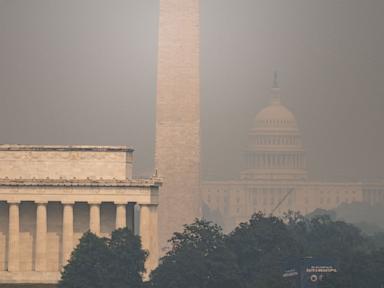
The sky outside isn't supposed to look like a dirty penny, but millions of Americans woke up to exactly that. A massive wall of dangerous wildfire smoke is currently slamming more than a dozen states across the Midwest and Northeast. If you look out your window in Philadelphia, Detroit, or Washington, D.C., you'll see a thick, acrid haze hanging in the air.
Philadelphia just triggered a Code Purple Air Quality Emergency. Chicago and Detroit saw their air quality index skyrocket into the hazardous zone. This isn't just an eyesore. It's a massive health hazard dropping right into your backyard. Meanwhile, you can read other stories here: Why The New Us Student Visa Cap Changes Everything For Indian Students.
The source isn't local. Canada is currently dealing with nearly 900 active wildfires, and over 100 of them are completely out of control. A massive cluster of these blazes is ripping through Ontario, right above the U.S. border. Strong, persistent winds are acting like a conveyor belt, pushing the toxic exhaust straight down into American cities.
The Toxic Map of Current Air Quality Alerts
You don't have to live near the woods to feel this. The smoke trail stretches all the way from Duluth, Minnesota, down to Richmond, Virginia. It engulfs major population hubs in Michigan, Ohio, Pennsylvania, New Jersey, New York, Maryland, and Delaware. To see the full picture, check out the detailed article by NPR.
The timing is brutal. Major cities are juggling this choking haze right alongside dangerous summer heatwaves. In Michigan, environmental officials put the entire state under an air quality alert while temperatures pushed heat indexes past 100 degrees Fahrenheit. Local governments had to cancel community events, outdoor concerts, and sports practices. You can't even go outside to cool off because the air itself is toxic.
The timeline for relief is messy. While Detroit and Chicago will get a brief break, the heaviest smoke plumes are steering east toward Buffalo, Boston, and Washington, D.C.. Even the weekend sports schedule is under threat. Thick haze is likely over New York City right when Spain plays Argentina in the World Cup Final at MetLife Stadium.
Why This Smoke Hits Your Lungs Harder Than You Think
Most people think wildfire smoke is just wood ash. It isn't. When a wildfire consumes an entire landscape, it burns homes, plastics, chemicals, vehicles, and industrial materials. The result is a toxic soup of fine particulate matter known as PM2.5.
These microscopic particles are less than 2.5 micrometers in diameter. That is roughly thirty times smaller than the width of a single human hair. Because they are so small, your body's natural defense mechanisms—like your nasal hairs and mucous membranes—cannot trap them.
You breathe them straight into your lungs. From there, they cross directly into your bloodstream. Yale School of Public Health expert Kai Chen notes that anyone working outdoors or belonging to a high-risk group needs to take this seriously. PM2.5 exposure triggers immediate systemic inflammation. It causes your heart rate to spike, irritates your respiratory tract, and forces your immune system into overdrive.
If you have asthma, COPD, or heart disease, this air can put you in the emergency room. Even if you are perfectly healthy, a few hours of breathing this stuff will leave you with a scratchy throat, a pounding headache, and stinging eyes.
How to Protect Your Household Right Now
Don't wait for the sky to turn completely orange before you take action. You can protect your indoor air quality with a few immediate steps.
First, lock down your house. Close every single window and door. Turn your air conditioning system to "recirculate" mode so it doesn't pull dirty air from the outside. If your HVAC system allows it, upgrade your filter to a MERV-13 rating or higher, which is dense enough to capture smoke particles.
Second, run standalone HEPA air purifiers if you have them. Place them in the rooms where you spend the most time, like your bedroom or living room. If you don't own an air purifier, you can build a makeshift DIY version by taping a high-quality furnace filter to the back of a standard box fan. It sounds crude, but atmospheric scientists prove it works in a pinch.
Third, change how you move outside. If you must go outdoors for work or errands, swap your cloth mask or surgical mask for a well-fitted N95 or KN95 respirator. Standard surgical masks have gaps on the sides that let smoke slide right past. An N95 blocks at least 95% of those tiny airborne particles. Skip your outdoor workouts entirely until the air quality index drops back into a safe green zone.
Storm systems moving across the Midwest might bring temporary clearing, but incoming rain can also pack lightning strikes that ignite new blazes. Track your local air quality index daily through real-time monitoring tools like AirNow.gov to know exactly when it is safe to breathe easy again.


