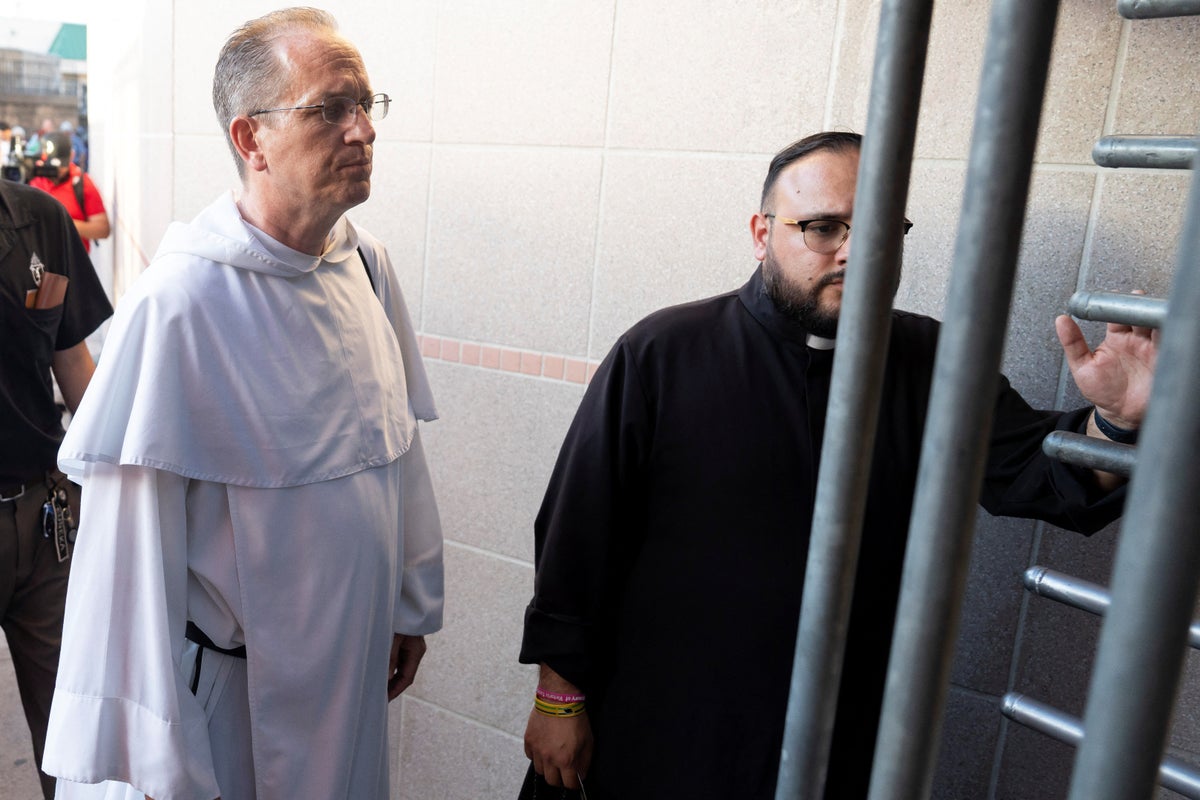
The physical barrier slicing through Nogales doesn't stop the heat, and it certainly doesn't stop the rosary beads. On a scorching Friday evening in late June 2026, with the mercury hitting 96 degrees Fahrenheit, a procession of more than 100 Catholic bishops, priests, nuns, and regular churchgoers walked directly toward the international boundary line.
They weren't there for a photo-op. They were executing a coordinated, highly public rebuke of the escalating immigration crackdown.
As the U.S. prepares to mark its 250th anniversary, the Catholic Church is taking an increasingly defiant stand against mass deportations, detention facility conditions, and recent legal shifts. For anyone watching the border closely, this isn't just a sudden burst of religious activism. It's a fundamental clash between federal enforcement and deeply rooted religious mandates.
The Line in the Sand at Ambos Nogales
The procession started at Sacred Heart Church in Nogales, Arizona, an historic structure that looks directly over the towering federal border fence. Bishop James Misko of Tucson celebrated a Mass that quickly transformed from a traditional liturgy into an explicit political statement.
"We want to be well together. This is what the Church is all about," Misko told the packed pews, urging a more human and compassionate treatment of migrants.
Once the final blessings were spoken, the clergy didn't head back to the rectory. They lined up, raised a banner bearing the image of the Virgin of Guadalupe, and began walking. Praying the rosary aloud, they marched right through the border checkpoint into Nogales, Sonora, where Mexican Catholic leaders joined them. Federal officials on the scene simply waved them through.
For those on the ground, the symbolic walk mirrored a brutal, everyday reality. Sister Eileen McKenzie, a Franciscan nun working in the twin border communities known locally as Ambos Nogales, pointed out that the heat they endured during the march was a fraction of what people in the desert face. "We realized there are people crossing the desert right now, and they don't have any respite," McKenzie said. "It puts perspective on it. There are more and more people who are going farther and farther out. They are more desperate and they are still crossing."
Denied Access and Dying Detainees
While the Nogales procession grabbed headlines, the real friction is happening behind closed doors in federal holding cells. Church leaders are sounding the alarm over what they call a severe restriction of religious liberty inside detention camps.
Bishop Mark Seitz, who heads the Diocese of El Paso, Texas, has been tracking the grim conditions at the Camp East Montana detention center near Fort Bliss. The facility has faced intense scrutiny following three migrant deaths between December and January, forcing the U.S. Department of Homeland Security to alter its contract administration.
According to Seitz, federal authorities are actively blocking pastoral care. Priests are currently restricted to celebrating just one Mass per week, on Sundays, capped at roughly 100 detainees. The facility holds well over 1,000 people.
"Most of these people that are being detained right now, they're not elderly people," Seitz stated bluntly. "They're not generally sick people. And yet they're dying. And there are many emergency calls from there to people who are suffering mightily."
✨ Don't miss: nsa mid south millington tn
Seitz points out the bitter irony of the situation. Roughly 80% of the detained population identifies as Catholic. At the exact moment they face their deepest crisis, the state is limiting their access to the sacraments.
Why the Church is Escalating the Fight
To understand why the bishops are turning up the volume, you have to look at the broader institutional backdrop. The timing of the Nogales march wasn't random. It was designed to contrast sharply with the upcoming American sestercentennial celebrations, highlighting the historical and modern contributions of immigrants.
The institutional resistance has been building for months.
- November 2025: The United States Conference of Catholic Bishops issued a sharp Special Pastoral Message on Immigration, directly condemning the "vilification of immigrants" and sounding warnings over massive enforcement sweeps.
- June 25, 2026: The U.S. Supreme Court handed down a major ruling allowing the administration to reimplement "metering"—a policy that permits border agents to turn away asylum-seekers before they even set foot on American soil to trigger legal protections.
- The Mountain Battle: Meanwhile, the Diocese of Las Cruces, New Mexico, is locked in a fierce federal court battle. Led by Bishop Peter Baldacchino, the diocese is fighting the administration's attempts to seize portions of Mount Cristo Rey—a sacred 90-year-old pilgrimage site capped by a 29-foot statue of Christ—to build a segment of the border wall. Baldacchino has called the wall "a physical symbol of the government's dehumanizing treatment of migrants writ large" and an outright "affront to religious liberty."
This isn't a regional anomaly. It's a global strategy. Dylan Corbett, executive director of the HOPE Border Institute and a member of a key Vatican advocacy group, notes that the Church is operating a massive humanitarian infrastructure along the entire migrant trail—from Venezuela and Haiti through Central America, and right up to the U.S. border. Even Pope Leo plans to celebrate an upcoming Mass on July 4 on the Italian island of Lampedusa, a major Mediterranean arrival point for refugees, reinforcing the global message.
Moving Beyond the Pews
The Catholic Church's position on immigration balances two core principles: the sovereign right of nations to secure their borders, and the moral duty to treat every human being with dignity. Right now, church leaders clearly believe the scales have tipped entirely toward brutality.
If you want to understand or support the humanitarian efforts happening along the border, here is how to track the work and find legitimate avenues for action.
- Monitor Local Legal Challenges: Track the ongoing land condemnation lawsuit filed by the Diocese of Las Cruces regarding Mount Cristo Rey to see how religious liberty arguments are being used to halt wall construction.
- Support Verified Direct Aid: Organizations like the HOPE Border Institute and Catholic Charities border chapters provide direct, on-the-ground food, water, and legal aid to families navigating processing centers.
- Review the Pastoral Directives: Read the Pilgrims of Hope pastoral reflections published by the USCCB to understand the specific legal and theological arguments the Church is using to counter current federal border enforcement policies.