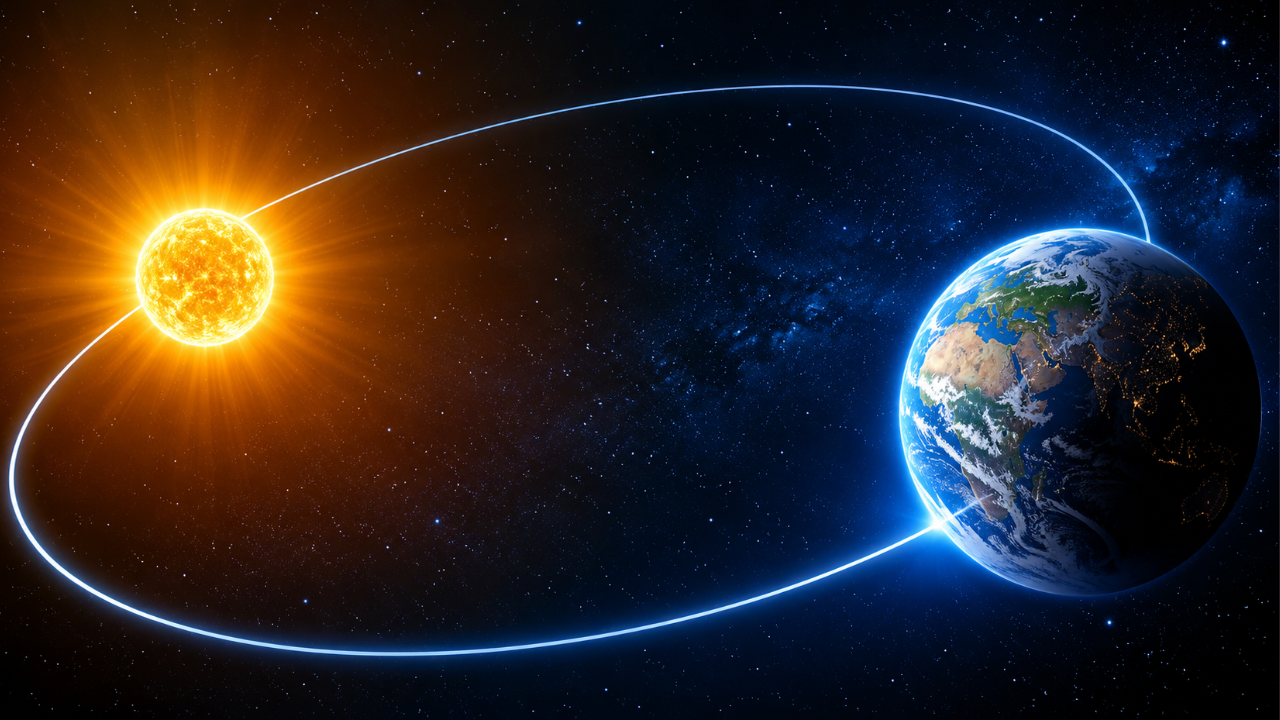
You are sweating through your shirt, the air conditioner is humming a relentless tune, and the pavement outside looks like it is about to melt. It is early July, the peak of summer across the Northern Hemisphere. If I told you that right now, at this exact moment, you are actually standing farther away from the Sun than at any other point in the entire year, you would probably tell me to check my thermometer.
It sounds entirely backward. Most people grow up with a simple, intuitive picture of the solar system in their heads. We think of the Sun as a roaring campfire. If you want to get warm, you move closer to the flames. If you get too hot, you back away.
But space does not care about campfire logic.
On July 6, 2026, Earth to reach its farthest point from the Sun on July 6, an annual astronomical milestone that scientists call aphelion. At exactly 17:30 UTC on that day, our planet will sit at a staggering 152.1 million kilometers away from our central star. Compare that to early January, when we hit our closest point, or perihelion, creeping in at roughly 147.1 million kilometers.
We are talking about a difference of five million kilometers. That is not a minor rounding error. It is a massive gulf of empty space, a distance that would take a commercial airliner more than half a century to fly. Yet, despite this massive separation, July remains notoriously scorching throughout Europe, Asia, and North America.
Why doesn't this extra distance cool us down? The answer exposes a fundamental misunderstanding of how our planet functions, and it reveals a brilliant quirk in orbital mechanics that actually makes our northern summers last longer than they should.
The Campfire Myth and the 23.5 Degree Angle
To understand why distance fails to dictate our daily weather, you have to look at the geometry of our planet. Earth does not sit perfectly upright as it journeys through the void. It leans.
Our planet is tilted at an angle of 23.5 degrees relative to its orbital plane. This lean is the absolute dictator of our seasons. During the month of July, the Northern Hemisphere is tilted directly toward the Sun, while the Southern Hemisphere points away into the cold darkness of space.
Think about holding a flashlight inside a dark room. If you shine the beam straight at a wall, all that light packs into a tight, intense, blinding circle. That is what July looks like for the Northern Hemisphere. The Sun climbs high in the sky, and its rays hit the ground at a steep, direct angle. The energy is concentrated.
Now, tilt that flashlight. The same amount of light spreads out into a wide, dim oval. The brightness fades because the energy is forced to cover a much larger surface area. That is winter. In the Southern Hemisphere right now, towns in Australia and Argentina are experiencing this exact dilution. Their sunlight is weak, striking the ground at an oblique angle, while their days are short and their nights are long.
The sheer volume of solar energy delivered by long, direct summer days completely overwhelms the minor drop-off caused by our distance from the Sun. You get fourteen or fifteen hours of intense, direct solar radiation every day. A three percent variance in orbital distance cannot compete with that kind of energetic onslaught.
The Numbers Behind the Energy Drop
Let's talk numbers, because vague explanations do not cut it. Does the distance matter at all? Yes, it does change the physical reality of the solar energy hitting our outer atmosphere.
Because we are farther away at aphelion, the total solar energy striking Earth as a whole is about seven percent less intense than it is in January. The Sun itself even looks slightly smaller. If you took a photograph of the Sun in January and stacked it directly against a photograph taken on July 6, you would notice the July Sun is about three percent smaller in the sky.
You cannot see this difference with the naked eye, and honestly, you should never look directly at the Sun to try. But sensitive astronomical instruments track it easily.
A seven percent drop in solar radiation sounds like a lot. If a heater in your house dropped its output by seven percent, you would notice. But on a planetary scale, this drop is absorbed and masked by a massive natural buffer, our oceans and atmosphere.
Why the Oceans Keep Us Sweating
Earth is a water world. Oceans cover more than seventy percent of the planet's surface, and water possesses a remarkable physical property called high specific heat capacity. This means water requires a massive amount of energy to change its temperature, and once it gets hot, it holds onto that heat with terrifying efficiency.
The distribution of land and water across the globe is deeply uneven. The Northern Hemisphere is packed with continents. It holds the vast majority of Earth's landmass, including North America, Europe, and Asia. The Southern Hemisphere, by contrast, is dominated by vast expanses of open ocean.
Land heats up incredibly fast compared to water. When the Northern Hemisphere tilts toward the Sun in July, all those massive landmasses bake rapidly under the direct sunlight. The oceans absorb the heat too, but they act like a giant planetary battery, storing the energy and slowly releasing it into the atmosphere.
This thermal reservoir effect completely smooths out the seven percent dip in solar intensity caused by aphelion. The atmosphere is already loaded with trapped heat, and the greenhouse gases present in our air act like a thick blanket, keeping that warmth locked down at the surface. By the time July 6 arrives, the northern continents have been soaking up intense sunlight for months since the spring equinox. The machine of summer is already in full motion, and a small shift in orbital distance cannot put the brakes on it.
Kepler Second Law and the Secret of Longer Summers
There is an even weirder consequence of aphelion that almost nobody talks about. It involves a seventeenth-century German astronomer named Johannes Kepler, who figured out that planetary orbits are ellipses, not perfect circles.
Kepler formulated a rule known as the Law of Equal Areas, which boils down to a simple reality: planets do not move at a constant speed around the Sun. When a planet is closer to the Sun, the gravitational pull is stronger, and the planet accelerates. When it is farther away, the gravitational grip slackens, and the planet slows down.
Because Earth reaches aphelion on July 6, our planet is currently moving at its slowest orbital speed of the entire year. We are coasting through space at roughly 105,400 kilometers per hour. In January, we fly along at nearly 109,000 kilometers per hour.
This slowdown has a direct impact on your calendar. Because Earth moves slower when it is far from the Sun, it takes longer to travel through the summer arc of its orbit.
As a result, summer in the Northern Hemisphere lasts about five days longer than winter. Think about that next time you are complaining about a July heatwave. The very astronomical event that should theoretically cool us down is actually prolonging the hottest season of the year. We get a longer summer because our planet is taking its sweet time rounding the far edge of its orbital track.
The Southern Hemisphere Paradox
If you want to see where this orbital dance gets truly interesting, look south. The Southern Hemisphere experiences winter during aphelion and summer during perihelion.
On paper, this sounds like a recipe for absolute extremity. Their summer happens when Earth is closest to the Sun, meaning they get hit with seven percent more solar intensity than the northern summer ever receives. Conversely, their winter happens when Earth is farthest from the Sun, which should make it brutally cold.
But the real world does not play out that way. Thanks to those massive southern oceans we talked about, the extreme spikes are flattened. The southern oceans soak up that extra seven percent solar blast during January, preventing South America, South Africa, and Australia from turning into absolute infernos. During their winter in July, those same oceans slowly release stored heat, keeping the winter conditions far milder than they would be on a planet made entirely of dry rock.
It is a beautiful system of planetary balance. The distribution of continents and oceans works in tandem with our orbital path to stabilize the global climate, keeping both hemispheres entirely habitable despite the erratic shifts in our distance from our star.
Practical Steps for Visualizing Aphelion
You cannot feel Earth slowing down, and you cannot feel the extra five million kilometers of space separating you from the Sun on July 6. But you can appreciate the scale of our solar system with a few practical steps.
First, track the sunset times. Notice how the evenings seem to stretch out endlessly. This is the peak of the northern solar intake.
Second, pay attention to the moon. July offers spectacular night skies. Because the atmosphere is holding onto immense amounts of daytime heat, evening stargazing is incredibly comfortable. Look out for the subtle shifts in the night sky as the summer constellations take center stage, driven by our position on the outer edge of our annual loop.
Ultimately, aphelion is a reminder that our senses only tell part of the story. We feel the blistering heat and assume we must be close to the fire. In reality, we are standing on a tilted rock, hurtling through a vacuum at mind-boggling speeds, drifting far out into the deep country of our solar system while our tilted home keeps us warm. Enjoy the extra long days while they last. The orbital clock is ticking, and by January, we will be flying high and close once again.
This video provides an excellent visual journey through Earth's aphelion and explains how the unique tilt of our planet dictates our seasonal weather patterns: Earth Is Farthest from the Sun Now