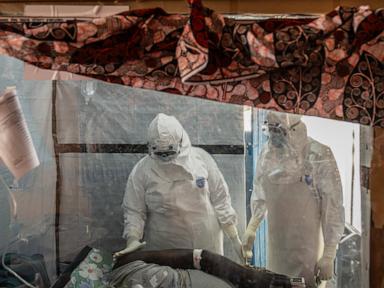
Public health workers are packing their bags and running for their lives in the northeastern Democratic Republic of the Congo. It’s a harsh reality that exposes a brutal truth. You can have the best medical protocols in the world, but they mean absolutely nothing if the community wants to burn your clinic to the ground.
The current Ebola response in Congo is facing an absolute catastrophe. We aren't just dealing with a lethal pathogen. We are dealing with an explosive cocktail of armed attacks, community fury, and a striking workforce left unpaid for months. The numbers coming out of Ituri province are terrifying. With 2,181 cases and 864 deaths recorded so far, this has officially become the fastest-growing Ebola outbreak on record. Yet, instead of ramping up operations, international aid groups and local medical teams are fleeing the hot spots.
If you think this is just another standard health crisis that can be solved by throwing money and supplies at it, you're dead wrong. The breakdown isn't medical. It's social and structural.
The Reality Behind the Ebola Response in Congo
To understand why everything is falling apart, you have to look at what happened in the town of Nyakunde. A local woman died at a medical facility. Within hours, an angry mob stormed the hospital. They shattered windows, threatened staff, and destroyed equipment. Local residents believed the facility itself was a death trap, or worse, that the workers were fabricating the disease for profit.
This wasn't an isolated incident.
Pierre Akilimali, the incident manager for the Ebola response, recently confirmed that at least a dozen major attacks on health facilities and workers have been documented during this single outbreak. Think about that for a second. Twelve separate instances of targeted violence against the very people trying to stop a deadly virus.
"Members of the various response teams have been held captive in some health zones," operations manager Dr. Adelard Lufongola warned at a recent briefing in Bunia. "Teams responsible for safe and dignified burials have been threatened and continue to be threatened in some cemeteries and within several communities."
When field workers face hostage situations and death threats, they stop going into the field. Over the last few days, aid teams have completely abandoned remote communities in Ituri province, retreating to the safer provincial capital of Bunia. The result? Vulnerable villages are left completely exposed, with zero surveillance, zero contact tracing, and nobody to manage new infections.
Why the Bundibugyo Strain Changes Everything
This isn't the standard Ebola outbreak everyone remembers. The virus ripping through Ituri right now is the Bundibugyo strain.
Most people associate Ebola outbreaks with the Zaire strain, which benefited from massive pharmaceutical breakthroughs over the last decade. During past outbreaks, responders deployed Ervebo, a highly effective vaccine, along with powerful monoclonal antibody treatments like Inmazeb and Ebanga. Those tools saved countless lives.
This time around, those tools are useless.
- The Bundibugyo virus is structurally distinct from the Zaire strain.
- There is no approved vaccine for the Bundibugyo virus.
- There are no approved therapeutic treatments available for this strain.
We are basically fighting this outbreak with our hands tied behind our backs. Without a vaccine to create a ring of immunity around infected communities, the response must rely strictly on classic, old-school public health measures. That means early detection, strict isolation, aggressive contact tracing, and safe burials.
Every single one of those measures requires total trust from the local population. And right now, that trust is completely nonexistent.
The Clash Between Science and Culture
Why is the local community so incredibly angry? It comes down to how public health mandates strip people of their humanity during their darkest moments.
Ebola spreads through direct contact with bodily fluids. A corpse is at its most contagious right after death. Because of this, response teams enforce strict, managed burial protocols. They keep family members away. They wrap the deceased in body bags. They bury them quickly in designated areas.
Now look at it from the perspective of a grieving family in Ituri.
Traditional funerals require loved ones to wash, touch, and prepare the body for the afterlife. It's a sacred ritual. When outsiders in white biohazard suits roll into a village, seize a family member's body, and refuse to let the parents kiss their child goodbye, it feels like an act of war.
Misinformation fills the void instantly. Rumors spread on social media and through word of mouth that Western organizations are stealing organs, or that health workers are injecting people with the virus to secure international funding. When a patient enters an isolation ward and dies alone, the community doesn't see a tragic medical failure. They see murder.
The Ultimate Betrayal: Striking Workers
If the violence wasn't enough to kill the response, the internal management of the campaign is doing the job. Frontline workers, the local Congolese nurses, burial teams, and drivers who take the highest risks, have gone on strike.
Why? Because they aren't getting paid.
Imagine risking your life every single day, facing the threat of a horrific disease and the physical danger of an angry mob, only to have the bureaucracy stiff you on your salary. It's completely unacceptable. International agencies and the central government pour millions into these responses, yet the cash rarely trickles down to the people doing the actual work on the ground.
When the local staff walks out, the response completely freezes. Foreign experts don't speak the local languages. They don't know the terrain. Without the local workforce, you have no eyes and ears on the ground.
What Actually Needs to Happen Right Now
We need to stop repeating the exact same mistakes from past epidemics. The current strategy is a proven failure. Here is the concrete blueprint required to turn this disaster around before it spills across borders into neighboring Uganda.
1. Route the Funds Directly to the Frontline
The striking workers must be paid immediately, with full transparency. Pay them hazardous duty bonuses directly to their mobile money accounts, bypassing the corrupt administrative channels that siphon off emergency funds. If the people managing the bodies and tracing the contacts walk away permanently, the outbreak cannot be contained.
2. Transition to Community-Led Isolation
Forcing people into giant, intimidating regional treatment centers builds resistance. Instead, response leaders need to fund and train local community leaders to manage low-risk isolation zones within their own villages. Let families see their loved ones through protective screens. Demystify the clinical space by making it accessible, local, and transparent.
3. Compromise on Burial Rituals
Public health officials must adapt to local customs rather than trying to obliterate them. Allow family members to participate in burials from a safe distance. Let them dress the body bag in traditional garments. Bring in local religious leaders to perform rites before the burial takes place. Respecting the dead is the only way to get the living to cooperate.
4. Deploy Local Security Liaison Networks
Bringing in heavy military escorts often escalates tensions, making health workers look like an occupying force. Instead, teams must embed trusted local elders and youth leaders into the response units. These liaisons can gauge community anger before a team enters a village, defusing rumors before they turn into riots.
The window to control this Bundibugyo outbreak is closing fast. If international donors and public health directors don't pivot their strategy immediately, the list of casualties will skyrocket well past the current numbers. It's time to stop treating this as a purely medical issue and start addressing the human crisis driving it.