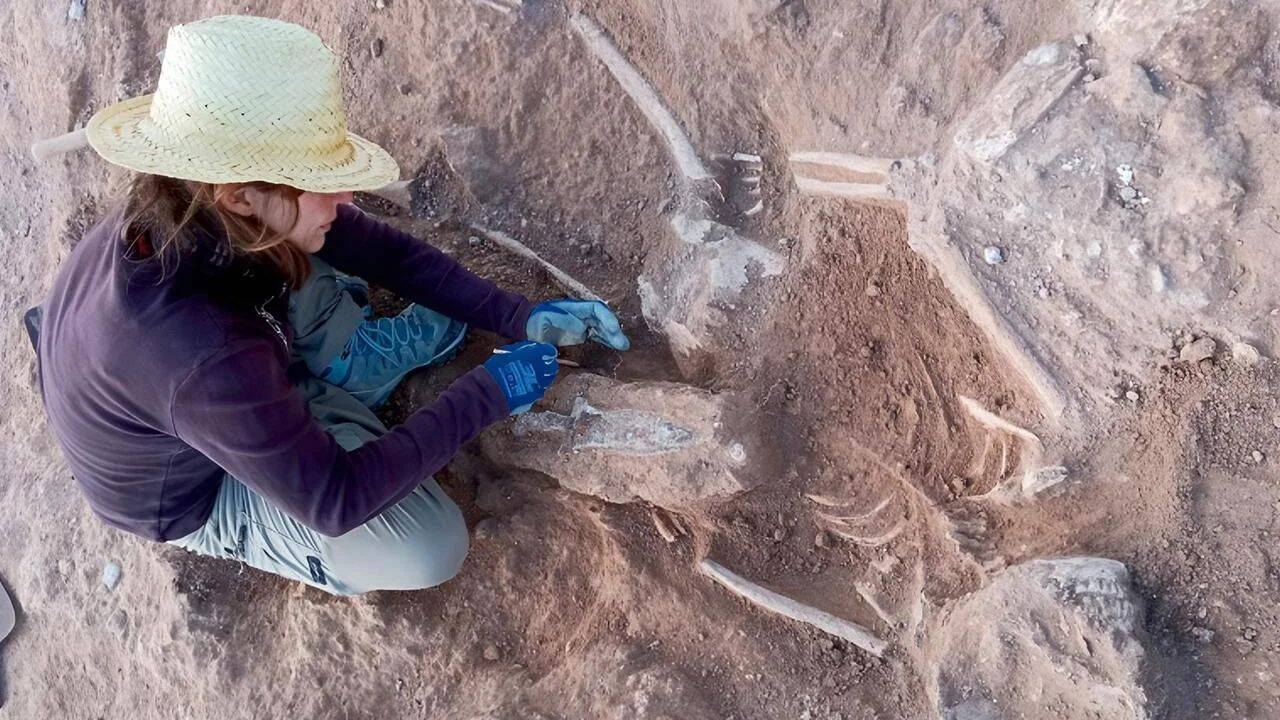
Imagine spending months digging up a massive, 5,000-year-old prehistoric fortress only to find something that completely shatters your timeline. That is exactly what happened to a team of archaeologists in southwestern Spain. They were busy mapping out an incredibly advanced Copper Age fortification when they stumbled on a solitary grave.
Inside lay the skeleton of a young man from the Roman Empire. He was buried 2,500 years after the fortress was abandoned.
This was not a standard burial. The man was stuffed into a shallow trench, laid flat on his stomach, and his feet were completely missing. To make things stranger, a standard-issue Roman military dagger was placed directly on his back. It is a bizarre, grim archaeological puzzle that has forced researchers to rethink what provincial security looked like on the fringes of Roman Spain.
The Solar Project That Accidentally Exposed a War Zone
The discovery happened near the town of Almendralejo in the Extremadura region of Spain. A renewable energy company, Acciona Energía, was doing routine land surveys for a planned photovoltaic solar park on an estate called Cortijo Lobato. Because Spanish laws require archaeological vetting before heavy construction, a private archaeology firm named Tera S.L. took the lead on checking the area.
They expected a few scattered artifacts. Instead, they found a massive pentagonal fortress crowning a hill 314 meters above sea level.
Led by archaeologist César Pérez, the team exposed a defensive complex built around 3000 BC. It was a massive architectural feat for the late Neolithic and Copper Age. The complex featured three concentric stone and earth walls up to five meters high, 25 rounded bastions jutting out to give defenders clear lines of sight, and three deep defensive ditches.
Inside the walls, the team found everyday items of prehistoric life:
- Copper arrowheads and stone axes
- Grinding stones for grain
- Ceramic plates and bowls
- Components of ancient weaving looms
The fortress did not face a peaceful end. Carbon-14 dating of animal remains found in a thick layer of ash shows the site was completely abandoned around 2450 BC. The team discovered that the heavy wooden doors embedded in the fortress's adobe walls had been deliberately torched. Because these doors were far from any other flammable materials, it points to a violent, coordinated assault that breached the defenses and left the entire settlement in ashes.
After that fire, the hill fell silent for 2,700 years. Then came the Roman army.
The Body in the Ditch
During excavations near the second prehistoric defensive ditch, the team hit a layer of soil dating to the Late Roman Empire, specifically around the late first century BC. That is where they found the shallow grave.
The grave contained a nearly complete skeleton of a man between 25 and 35 years old. The physical evidence points to an intentional, highly specific act of disrespect or punishment.
The man was buried face down. His feet had been cleanly severed before burial. The pit itself was barely deep enough to hold his torso, suggesting whoever buried him was in an extreme hurry. And then there was the weapon: a perfectly preserved Roman pugio, or military dagger, still sitting inside its sheath, placed directly on his back.
Decoding the Roman Army Dishonorable Discharge
At first, the archaeological team debated whether this man was just a local civilian who happened to buy or steal a military blade. César Pérez and his team ultimately concluded that the intentional placement of the pugio indicates a formal military identity.
During the late Republic and early Empire, the pugio was not just a tool for self-defense. It was a regulated piece of equipment that symbolized an individual's official status within the Roman military machine.
Leaving a soldier with his weapon but burying him face down with his feet cut off strongly suggests a dishonorable burial. In the Roman world, executions for desertion, treason, or mutiny often involved bodily mutilation to deny the individual a proper transition into the afterlife. Forcing a body face down into a shallow grave was a clear message of disgrace.
If forensic testing confirms he was a regular soldier, he likely belonged to Legio VII Gemina. This was the only permanent Roman legion stationed in Hispania during this era.
Legio VII Gemina had its main headquarters way up north in modern-day León. They were not fighting massive frontline wars in the south. Instead, their daily routine involved provincial security, patrolling trade roads, escorting valuable officials, and guarding tax shipments. A lone soldier operating far from headquarters on a security detail would make an easy target for bandits, local insurgents, or even betrayal by his own companions.
What Forensic Science Is Targeting Next
The field work at Cortijo Lobato is wrapping up, but the laboratory investigation is just getting started. The recovered pugio has been sent to Madrid Complutense University, where restoration specialist Maicu Ortega is cleaning, consolidating, and stabilizing the metal to prevent it from flaking into dust.
Anthropologists are focusing heavily on the skeleton's teeth. They are attempting to extract ancient DNA and isolate strontium isotope ratios from the tooth enamel. Because strontium signatures reflect the water and soil of a person's childhood home, this data will tell us exactly where this man grew up. Was he a local Spanish recruit, or did he march across Europe from Italy, Gaul, or Germany only to meet a brutal end on a lonely hill?
The bone analysis will also search for micro-fractures, signs of disease, or signs of malnutrition that might reveal how he lived before his final day. For now, the exact cause of death remains hidden.
Keep Track of Regional Digs
If you want to understand how deep these ancient military puzzles go, you should track the active archaeological portfolios across Extremadura and Andalusia. The expansion of solar energy projects in southern Spain is forcing massive tracts of farmland to be excavated for the first time, meaning discoveries like Cortijo Lobato are happening faster than academic journals can publish them. Check the updates regularly through the Spanish National Research Council (CSIC) portal to see the latest raw data sheets as they get uploaded.