You are standing perfectly still right now, but you are actually hurtling through space at over a thousand miles per hour. Your body cannot feel it. Your eyes cannot see it. For thousands of years, humans looked up at the sky and assumed the sun and stars were doing all the hard work of circling around us. Even after Copernicus and Galileo told everyone that the planet spins on an axis, nobody had a simple, direct way to look down at the floor and actually watch it happen.
That changed on a cold winter morning in Paris in 1851.
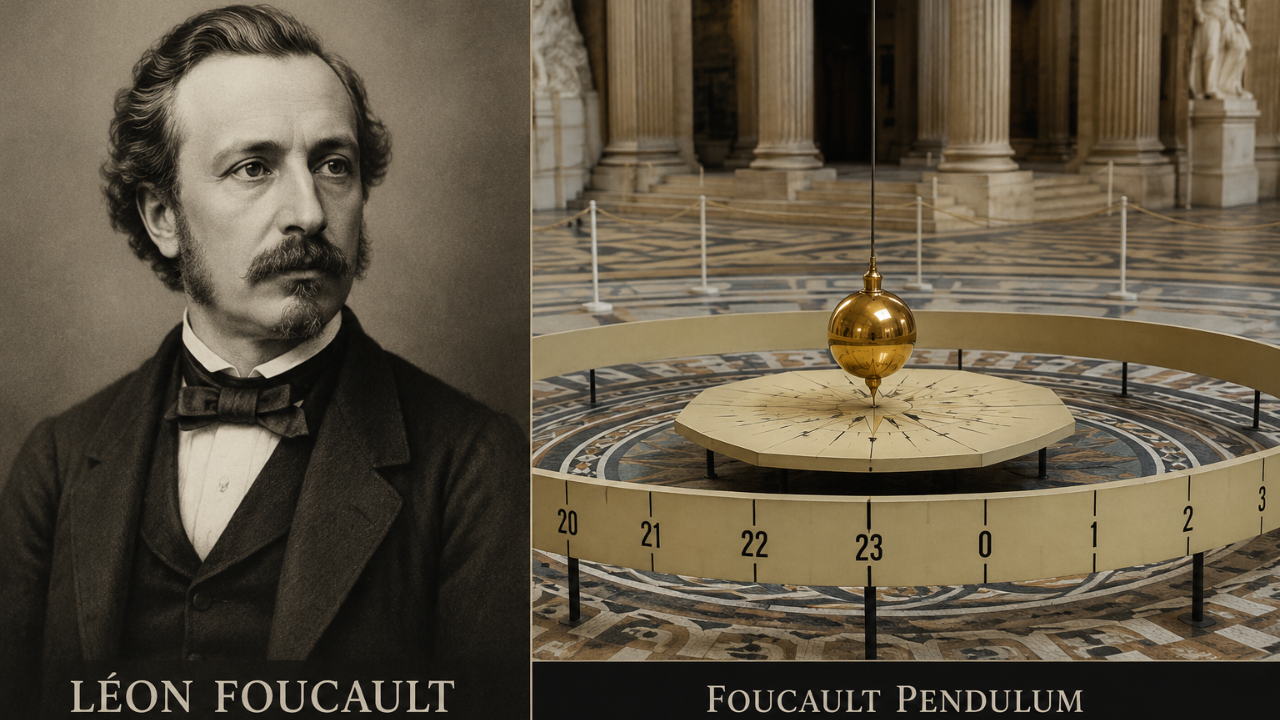
A self-taught French physicist named Léon Foucault rigged a heavy metal ball to a long wire and let it swing. He didn't build a massive telescope or calculate complex planetary orbits. He used a basic physical property that anyone can understand. By letting a giant weight swing freely, he gave the public a front-row seat to the motion of our planet. The Foucault pendulum experiment remains one of the most brilliant visual demonstrations in scientific history because it takes an invisible cosmic fact and makes it undeniably real.
The Simple Hack That Proved a Cosmic Truth
Before Foucault, proving the rotation of the Earth required a lot of trust in astronomers. You had to look through a lens, track the stars over weeks, and crunch a mountain of numbers. If you were an ordinary person walking the streets of Paris, you took the scientists at their word.
Foucault changed the game by looking at a workshop tool. He noticed that if you clamp a flexible metal rod into a lathe, set it vibrating, and then spin the lathe itself, the rod keeps vibrating in the exact same direction. The spinning base doesn't force the vibrating rod to turn with it.
He realized that a pendulum behaves the exact same way. If you hang a massive weight from a long cable and set it swinging, it wants to keep swinging in the exact same plane forever. Newton's laws of motion state that an object in motion stays in motion along a straight line unless acted upon by an outside force. A perfectly balanced pendulum hanger has no mechanism to twist or pull the swing sideways.
So, if you set that pendulum in motion and notice that the line of its swing slowly drifts over several hours, the pendulum isn't turning. The building you are standing in is turning. The city is turning. The entire planet is turning right under your feet.
Inside the Famous 1851 Pantheon Spectacle
Foucault didn't start with his famous grand display. He tested his idea in his own cellar first in January 1851 using a relatively small two-meter wire and a five-kilogram weight. It worked. He then scaled it up for a private demonstration at the Paris Observatory in February.
The real magic happened when he got permission from Louis-Napoleon Bonaparte, who was then the president of the French Republic, to use the massive dome of the Panthéon in Paris. This was no longer just a private lab experiment. It became an interactive public exhibition.
Foucault suspended a 28-kilogram brass-coated lead ball from the ceiling using a steel wire that stretched 67 meters long. He wanted to make sure the swing stayed straight, so he didn't just push the ball by hand. Human hands are clumsy. Giving it a manual shove introduces a slight sideways wobble, which ruins the tracking. Instead, Foucault pulled the giant ball to one side and tied it to a wall with a thin cotton thread. He waited for the heavy ball to come to a complete, dead rest. Then, he used a flame to burn through the thread.
The ball swung perfectly straight.
To show the crowd exactly what was happening, Foucault built a circular wooden platform covered in a lip of damp sand directly beneath the pendulum. A tiny metal point, or stylus, protruded from the bottom of the brass ball. Every time the ball reached the outer edge of its swing, the stylus carved a clean groove into the sand.
With every single back-and-forth arc, which took about 16 seconds, the point cut a fresh path a couple of millimeters to the side of the last one. Over hours, the lines in the sand fanned out to look like the petals of a geometric flower. The crowd stood in absolute silence as they watched the grooves creep clockwise around the room. They weren't just looking at a swinging ball. They were watching France rotate.
The Secret Math of Your Latitude
A common misconception about Foucault's pendulum is that it rotates at the exact same speed everywhere on Earth. It doesn't. If you set up this experiment at the North Pole or the South Pole, the math is incredibly clean. The planet rotates 360 degrees beneath the pendulum in one sidereal day, which is roughly 23 hours and 56 minutes. To an observer standing on the polar ice, the pendulum seems to rotate a full 15 degrees every hour.
Move away from the poles, and things get weird.
The rate of the pendulum's apparent rotation relies entirely on your specific latitude. The actual formula uses the sine of the latitude angle to calculate the speed.
$$\omega = \Omega \sin(\phi)$$
In this equation, $\omega$ is the rotation rate of the pendulum plane, $\Omega$ is the rotation rate of the Earth, and $\phi$ is the latitude.
Because Paris sits at roughly 49 degrees north latitude, the sine of that angle slows the apparent rotation down significantly. Instead of completing a full circle in 24 hours, the pendulum in the Panthéon takes about 32 hours to complete a full 360-degree loop, moving at roughly 11.3 degrees per hour.
If you take that exact same pendulum and set it up right on the equator, its latitude is zero degrees. The sine of zero is zero. At the equator, the plane of the pendulum does not rotate at all. You could sit there for a week, and the ball would swing back and forth along the exact same line until friction brought it to a halt. If you move down into the Southern Hemisphere, the entire rotation flips and runs counter-clockwise.
Why Keeping a Pendulum Moving is a Nightmare
If you visit a science museum today, you will likely see a Foucault pendulum swinging inside a grand staircase or lobby. It looks effortless. But if you talk to the museum curators who maintain those setups, they will tell you that keeping a pendulum running cleanly is an engineering nightmare.
Left to its own devices, air resistance and friction at the ceiling anchor point will drain energy from the swing. A standard pendulum will die out after a few hours. To keep it running indefinitely, modern displays hide an electromagnetic ring inside the floor or ceiling. This magnet gives the metal bob a tiny, precise pull on every single pass, replenishing the lost energy without altering the direction of the swing.
Another silent killer of the experiment is a physical quirk known as Airy precession. Named after astronomer George Biddell Airy, this effect happens when the pendulum tracking develops even the slightest elliptical shape. If the ball isn't released perfectly, or if a stray gust of air knocks it off course, it stops swinging in a flat, straight line and begins tracing a very narrow oval.
That oval shape creates a natural physical rotation that has absolutely nothing to do with the Earth's spin. In short pendulums, like the ones used in classrooms, Airy precession can completely overpower the Earth's rotation effect, causing the experiment to fail or show the wrong speed. Foucault instinctively knew how to mitigate this by using a massive 67-meter wire. The longer the wire and the heavier the bob, the less susceptible the system is to these tiny, destructive errors.
The Actionable Physics Checklist
If you want to experience or build a miniature demonstration of this phenomenon yourself, you need to account for the variables that Foucault mastered. You can recreate the foundational logic on a small scale, but you must avoid the classic traps.
- Max out your length: Short strings amplify errors. If you are building a demonstration model, use the highest ceiling available to give the pendulum a long, slow period.
- Isolate the anchor: The top hook must be completely free to pivot in any direction equally. A universal ball-bearing joint or a razor-edge suspension point prevents the mount from forcing the wire into a specific path.
- Use the thread trick: Never release a precision pendulum by dropping it from your hand. Tie it off, let it settle completely, and burn the string to ensure zero initial lateral velocity.
- Calculate your local speed: Don't expect a 24-hour rotation unless you are standing at the poles. Look up your town's exact latitude, find the sine value, and multiply it by 15 degrees per hour to know exactly what to look for.
Foucault's 1851 experiment remains a masterclass in science communication. It took a high-level astronomical concept that lived exclusively in textbooks and dropped it onto a dirt-and-sand floor where everyday citizens could watch it happen in real-time. It didn't invent new physics, but it brought the cosmos down to Earth.