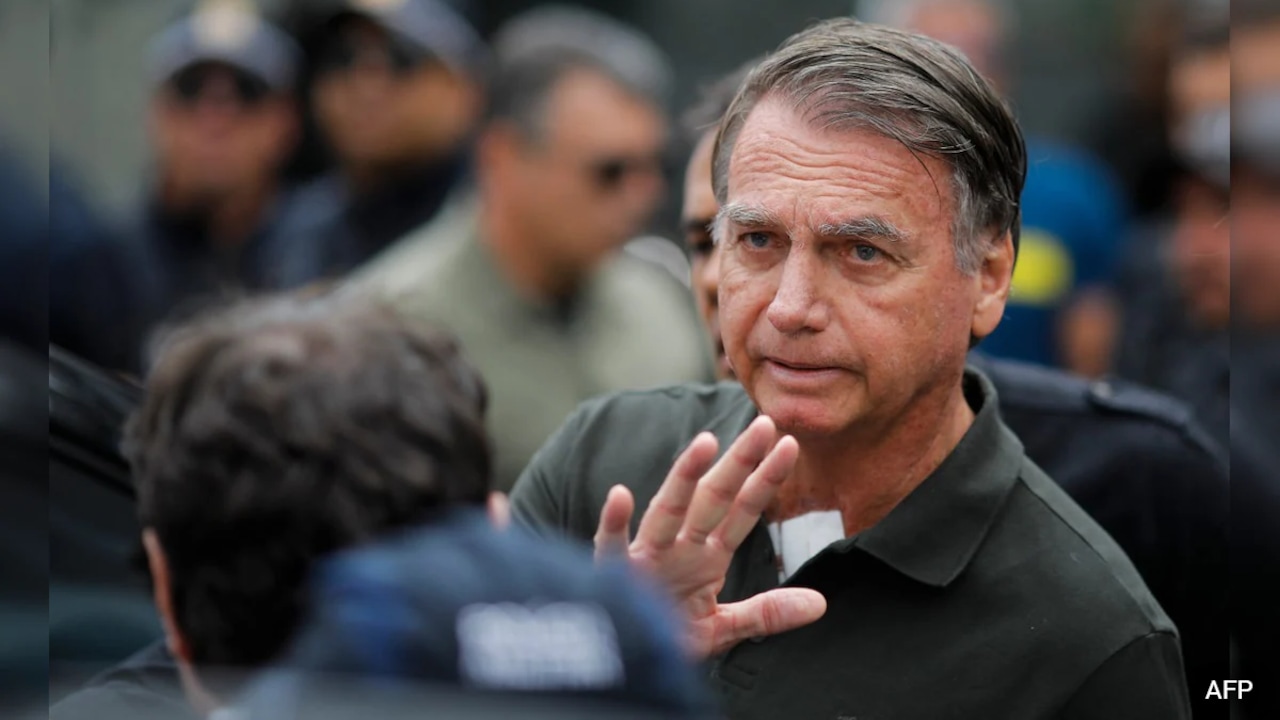
Jair Bolsonaro isn't going back to a standard prison cell anytime soon. Brazil Supreme Court Justice Alexandre de Moraes just extended the former president's humanitarian house arrest, keeping the 71-year-old leader confined to his gated community home in Brasilia. It's a massive sigh of relief for the right-wing populist, but it also underscores the delicate legal and political tightrope Brazil is walking right now.
Many onlookers assumed that Bolsonaro's recent run-ins with the law during his house arrest would send him straight back behind bars. Last month, federal police seized a firearm from a member of his security detail at a checkpoint. In the past, any slight deviation from court orders saw Moraes crack down hard on the former leader. This time, the court showed a surprising bit of leniency. In similar updates, we also covered: Why The Fight Over Online Gun Delivery Is Splitting America.
The decision centers squarely on his deteriorating health. Bolsonaro has spent years dealing with severe medical complications stemming from a 2018 campaign trail stabbing that nearly took his life. When you look past the courtroom drama, this ruling reveals a lot about how the Brazilian state wants to handle its most polarizing political figure without sparking a massive civil uprising.
The High Stakes Behind the Recent Court Decision
If you want to understand why this matters, you have to look at the sheer scale of the sentence hanging over Bolsonaro. He's currently serving a massive 27-year and 3-month prison sentence. The Supreme Court handed down that conviction in September 2025 after finding him guilty of masterminding a coup plot to stay in power after his 2022 election loss to current President Luiz Inacio Lula da Silva. Reuters has analyzed this critical issue in extensive detail.
For a man facing nearly three decades behind bars, spending that time inside a comfortable residence in the capital beats a jail cell every single day.
Moraes stated that keeping Bolsonaro under humanitarian house arrest right now is reasonable, appropriate, and proportionate. The judge acknowledged that Bolsonaro has shown some health improvement since he was allowed to leave the federal police headquarters back in March. Back then, an acute bout of pneumonia landed the former president in the intensive care unit with kidney complications, forcing the court to grant him a temporary 90-day medical release.
That 90-day window just wrapped up, and his legal team successfully argued that a return to regular prison would cause his health to plummet again. Prosecutor General Paulo Gonet backed this view, offering an official opinion that recommended keeping Bolsonaro at home despite the recent firearm incident involving his guard. Moraes agreed, noting there wasn't clear proof of serious personal misconduct by the former president himself during his initial time under house arrest.
From the Campaign Trail Stabbing to Chronic Health Battles
To really grasp why the courts are yielding on the health argument, you have to go back to 2018. While campaigning for the presidency, an attacker stabbed Bolsonaro in the abdomen. The blade caused deep internal damage, requiring multiple complex surgeries over the following years.
Ever since, his digestive track and internal organs have been a ticking time bomb.
During his presidency and his subsequent legal troubles, Bolsonaro has been hospitalized dozens of times for intestinal blockages, scar tissue issues, and infections. When federal agents locked him up in a larger cell in January 2026 after a brief stint in a smaller federal police unit, his health rapidly degraded. The tight conditions, high stress, and lack of specialized, immediate medical infrastructure inside the prison facility paved the way for the severe pneumonia that hit him in March.
His defense team played this hand perfectly. They didn't argue against the validity of his conviction this time around. Instead, they focused entirely on the humanitarian angle. They argued that the state has an obligation to keep high-profile prisoners alive, and forcing a 71-year-old man with a wrecked digestive system back into a standard cell was a recipe for a medical emergency that the government simply couldn't afford to have on its hands.
The Legal Battle and the 27-Year Prison Sentence
The actual charges that landed Bolsonaro in this mess are incredibly severe. The Supreme Federal Court convicted him on five separate counts, which included leading an armed criminal organization and attempting the violent abolition of the democratic rule of law.
The prosecution built a mountain of evidence showing that after Bolsonaro lost the 2022 election, high-level members of his administration and military allies drew up plans to prevent Lula from taking office. The investigation uncovered draft decrees to declare a state of emergency, arrest Justice Alexandre de Moraes, and potentially alter the election results.
The situation boiled over on January 8, 2023, when thousands of Bolsonaro's supporters stormed and vandalized the congressional building, the Supreme Court, and the presidential palace in Brasilia. While Bolsonaro was in Florida during the riots, prosecutors tied the intellectual backing of the movement directly to his inner circle.
The legal timeline moved fast after that:
- June 2023: The Superior Electoral Court bars Bolsonaro from seeking political office until 2030 for abusing his power and spreading unfounded doubts about the electronic voting system.
- February 2025: Federal investigators formally charge him with the coup plot.
- August 2025: The court places him under an initial house arrest order after he uses his son's phone to broadcast a live message to supporters, violating pre-trial rules.
- September 2025: The historic trial concludes with a guilty verdict and a 27-year sentence.
- November 2025: Bolsonaro tries to tamper with or remove his electronic ankle monitor using a soldering iron, leading federal police to take him into physical custody as a major flight risk.
- March 2026: Severe illness forces his transfer from a prison cell to the hospital, and eventually back to house arrest.
Why the Recent Firearm Incident Didn't Send Him Back
When news broke that a gun belonging to Bolsonaro was found on one of his security officers at a police checkpoint, critics figured his house arrest would be revoked instantly. Moraes has a reputation for showing zero tolerance for anything that looks like a violation of court terms.
But the legal mechanics saved Bolsonaro here. Under Brazilian law, former presidents are legally entitled to a small lifetime security detail paid for by the state. The security guards are active or retired law enforcement officers who carry firearms as part of their job protecting a former head of state.
Because the weapon was with the security guard at an external checkpoint and not being used by Bolsonaro to threaten anyone or plot an escape, Prosecutor General Gonet saw it as an administrative hiccup rather than a willful violation by the defendant.
Furthermore, Bolsonaro is living under incredibly tight restrictions right now. He wears an electronic ankle monitor at all times. He's completely banned from using cell phones or accessing social media. He can't give interviews to journalists or make public statements. Only his immediate family members, his legal defense team, and his attending doctors are allowed to step foot inside his home. Local police heavily surveil the perimeter of his gated neighborhood, and the court banned any political protests or gatherings near his house.
Basically, he's totally isolated from his political base. For the current government and the Supreme Court, this isolation achieves their main goal: it keeps him from mobilizing his millions of hardcore followers online while avoiding the optics of letting a sick former president die in a prison cell.
What Happens Next for Brazil and Its Most Polarizing Figure
This judicial compromise won't satisfy everyone. Bolsonaro's staunchest allies in Congress, led by his lawmaker sons Flávio and Eduardo, continue to scream that Brazil is living under a judicial dictatorship. They point out that Brazil's Congress actually voted to reduce Bolsonaro's sentence earlier this year, though that decision is tangled up in intense legal appeals and challenges from the executive branch.
On the flip side, Lula's supporters worry that keeping Bolsonaro at home sends a message of impunity. They argue that normal citizens serving sentences for far less serious crimes don't get the luxury of recovering from illness in a private, comfortable home.
But for now, the status quo stands. Moraes made it clear that this isn't a permanent pass. The judiciary will keep reviewing his medical records. If his health shows a massive, undeniable recovery, or if he slips up and uses a family member's phone to post a message on social media, the deal is off.
If you want to track where this goes next, keep your eyes on two specific things:
- The Official Medical Reports: The court will demand independent medical evaluations every few months to verify if his condition still requires home care.
- The Congressional Appeals: Watch how the Supreme Court handles the legislative attempts by right-wing lawmakers to grant an amnesty or a sentence reduction to Bolsonaro and his jailed allies.
The political drama in Brazil isn't over, but for the foreseeable future, the battleground remains confined to medical charts and courtroom filings while Bolsonaro stays under lock and key at home.