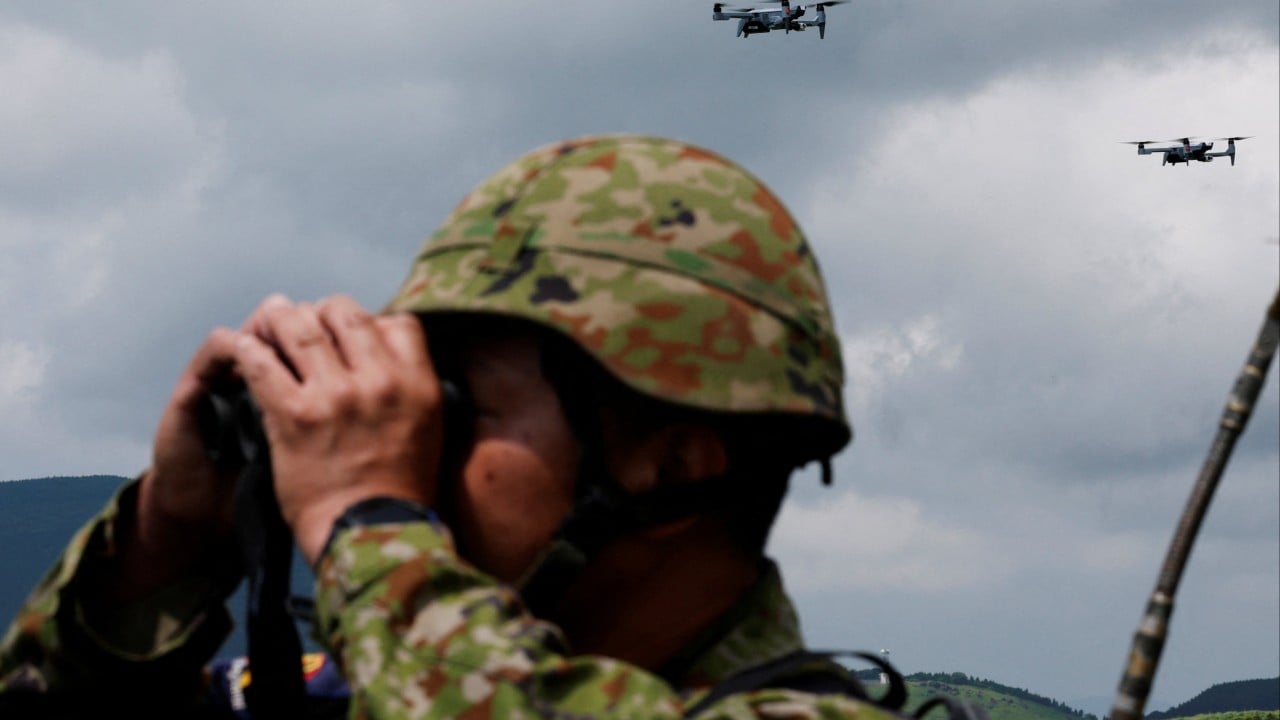
Military planners in Tokyo are facing a terrifying math problem. If an adversary launches a swarm of hundreds of cheap kamikaze drones toward Japanese radar stations or coastal ports, defending them with traditional air systems will cause immediate financial ruin. Firing a four-million-dollar Patriot missile to blow up a five-thousand-dollar flying plastic tube is a losing strategy. You run out of missiles long before the enemy runs out of targets.
This brutal reality has forced a complete overhaul of East Asian defense thinking. The race is on, and the Japan drone warfare Ukraine experience connection has become the foundation of Tokyo's new military playbook. Japan is no longer just watching the war in Europe from afar. Instead, Japanese defense firms and state officials are actively embedding themselves into the Ukrainian ecosystem to harvest real-time combat data and survival strategies.
They aren't looking for glossy brochures from traditional defense firms. They want the raw, messy, battle-tested solutions that only a high-intensity war zone can produce.
The Financial Math That Blew Up Old Traditions
For decades, the Japanese Self-Defense Forces focused on buying highly sophisticated, incredibly expensive Western hardware. They prepared for conventional, heavy-metal conflicts involving advanced fighter jets, massive naval destroyers, and heavy tanks. Then the skies over Kyiv and Kharkiv changed everything.
Ukraine proved that cheap, mass-produced unmanned aerial vehicles can systematically dismantle a massive, slow-moving military force. By early 2026, the numbers became impossible for Tokyo to ignore. Ukrainian units were using small, low-cost interceptor drones costing between one thousand and twenty-five hundred dollars to down incoming threats at a massive scale. In January 2026 alone, Ukrainian forces destroyed a record 1,704 Shahed-type kamikaze drones. Over seventy percent of those kills were achieved not by Western missile batteries, but by cheap, agile interceptor drones.
Tokyo realized its current systems would fail an endurance test. If conflict breaks out in the Taiwan Strait or around the Senkaku Islands, Japan needs thousands of cheap, disposable weapons that can fight in environments where electronic jamming turns high-tech guidance systems into junk.
Inside the Tokyo Kyiv Drone Alliance
This isn't just a theoretical exchange of academic papers. The cooperation has moved directly to the factory floor and the front lines.
In March 2026, a Tokyo-based drone developer named Terra Drone announced its full-scale entry into the defense equipment market. They didn't build a massive domestic factory in Japan. Instead, they made a direct strategic investment in Amazing Drones, a Ukrainian outfit that specializes in building interceptor platforms right under the shadow of Russian missile threats.
By mid-April 2026, this partnership yielded a working weapon: the Terra A1.
The operational details of this machine show exactly what Japan is trying to learn. The Terra A1 is a small, electric-propelled interceptor designed to hunt down slower loitering munitions like the Iranian-designed Shahed.
- Acceleration It jumps to 200 kilometers per hour within 10 seconds of launch.
- Top Speed It tops out at 302 kilometers per hour.
- Operational Range It covers a tight 32-kilometer radius.
- The Cost Factor Each unit costs roughly 400,000 yen, which translates to about $2,526.
Compare that twenty-five hundred dollar price tag to a multi-million-dollar interceptor missile. It completely flips the economic equation of modern air defense.
Terra Drone didn't stop there. In April 2026, they poured more capital into another Ukrainian defense tech firm called WinnyLab, which builds fixed-wing interceptors and specialized targeting software. This led directly to the deployment of the Terra A2 in May 2026. The A2 is a larger, fixed-wing craft that pushes the operational range out to 75 kilometers with a maximum flight time of 40 minutes and a top speed of 310 kilometers per hour.
These aren't test models sitting in a quiet hangar in Kyoto. They are flying combat missions in Ukraine right now. Japanese engineers are gathering data on battery performance under freezing conditions, how composite rotors handle explosive fragments, and how tracking algorithms respond when Russian electronic warfare systems try to blind them.
The Dangerous Reality of Distributed Manufacturing
Building weapons during a hot war means throwing out old manufacturing rules. You can't build a massive, centralized factory because a single ballistic missile strike will wipe out your entire production capability.
To survive, the Ukrainian drone industry relies on highly decentralized, small-scale production workshops scattered across the country. Some of these lines operate in basements, hidden warehouses, or deep underground in frontline cities like Kharkiv.
Terra Drone CEO Toru Tokushige has openly favored this distributed approach. It keeps production moving, but it also minimizes the physical risks for the Japanese technical experts and production specialists who travel to the region to assist with scaling.
But this setup creates massive challenges. Maksym Klymenko, the head of Amazing Drones, has noted that while Ukraine excels at rapid development and keeping costs incredibly low, it struggles with industrial mass production. Many assembly processes remain manual. The parts are put together by hand, which makes it hard to scale production to tens of thousands of identical units.
That is where Japan comes in. Tokyo brings world-class industrial engineering, quality control, and supply chain management. By blending Ukrainian battlefield speed with Japanese precision manufacturing, they hope to create an unstoppable assembly line.
The Demographic Crisis Driving the Unmanned Shift
Japan's sudden obsession with unmanned systems isn't just about watching global trends. It is a desperate response to a domestic crisis that cannot be solved by money alone. Japan is running out of people.
The Self-Defense Forces have missed their recruitment targets for years. By mid-2025, data showed the military was operating at just 89.1% of its authorized strength. The Ground Self-Defense Force was in even worse shape at 87.7%, and lower enlisted personnel numbers—the actual bodies needed to hold ground and fire weapons—had cratered to 60.7%. Demographers project that Japan's recruitment-age population will plummet by another 30% by the mid-2040s.
Put simply, Japan does not have the manpower to operate traditional military units. They cannot staff crews for hundreds of attack helicopters or thousands of armored vehicles.
Because of this crunch, Tokyo recently decided to entirely retire its fleet of manned attack and reconnaissance helicopters, replacing them completely with unmanned systems. Drones don't require twenty years of demographic growth to fill a cockpit. They don't leave grieving families behind when an enemy missile hits.
Fixing the Blind Spots in the SHIELD Program
The Japanese government knows it is behind. To fix this, Tokyo plans to spend roughly 1 trillion yen through fiscal 2027 to buy thousands of unmanned systems. Part of this funding feeds into the SHIELD Program, a 100-billion-yen effort funded in the fiscal 2026 budget proposal to deploy a massive network of air, surface, land, and underwater drones for coastal defense by March 2028.
But early planning for the SHIELD program revealed a massive flaw. It was a hardware procurement plan without a functional combat doctrine. Japan was planning to buy off-the-shelf systems from the United States, Turkey, and Australia, but defense planners didn't actually know how to deploy them effectively in a contested electronic environment.
Ukraine provides the missing piece of that puzzle. Ukrainian operators have spent years fighting in the most electronically jammed environment in human history. They know exactly how commercial GPS signals fail, how radio frequencies shift under pressure, and how to build optical tracking systems that allow a drone to dive on a target even when its link to the pilot is completely severed.
By absorbing Ukrainian tactical data, Japan can skip years of expensive, slow trial-and-error testing. They can build software that actually works against modern electronic countermeasures on day one.
Stealing Secrets From the Black Sea
The cooperation goes far beyond the air. Japan is an island nation with thousands of miles of vulnerable coastline. Tokyo's biggest nightmare is an amphibious invasion or a naval blockade that cuts off its maritime trade routes.
This explains why Tokyo is intensely interested in Ukraine's naval drone program. Ukrainian President Volodymyr Zelenskyy and Foreign Minister Andrii Sybiha have explicitly offered to share their maritime drone developments with Tokyo.
Think about what Ukraine achieved in the Black Sea. Without a functional conventional navy, Ukraine used low-cost, explosive-laden remote-controlled boats—like the Sea Baby—to systematically cripple Russia’s Black Sea Fleet. They forced heavily armed warships to retreat from Ukrainian shores and abandon critical ports.
For Japan, this is a revelation. Tokyo can use these exact same tactics to defend the First Island Chain. Instead of relying entirely on multi-billion-dollar destroyers that are vulnerable to hypersonic anti-ship missiles, Japan can deploy thousands of small, autonomous naval surface drones to patrol narrow straits and deter hostile fleets.
Legal Hurdles and the New Export Rules
The biggest roadblock to this alliance isn't technology or money. It is the law. Japan’s post-war pacifist constitution and its strict "Three Principles on Transfer of Defense Equipment and Technology" create massive legal friction.
Traditionally, Japan banned the export of lethal military hardware to any country involved in an active conflict. This meant Tokyo could send food, helmets, and non-lethal radars to Kyiv, but it couldn't directly send weapons or engage in joint military production that resulted in lethal systems on the battlefield.
To bypass these limits, the private sector is leading the charge. Companies like Terra Drone are investing directly in Ukrainian entities, shifting the intellectual property and manufacturing development overseas where Japanese domestic export laws don't apply. At the same time, Tokyo has steadily overhauled its export rules, scrapping old limits to allow the overseas sale of certain lethal systems on a case-by-case basis.
The pressure of the geopolitical situation is forcing Tokyo to move faster than anyone thought possible. In early 2026, bilateral talks began to formalize an intergovernmental agreement on the transfer of defense equipment and technologies between Japan and Ukraine.
What Tokyo Must Do Right Now
The window of opportunity to learn these lessons won't stay open forever. To secure its defense posture before a regional crisis erupts in Asia, Tokyo needs to take immediate steps.
First, Japanese defense planners must stop treating drones as an add-on accessory to traditional units. Unmanned systems must become an independent branch of military doctrine, with dedicated operational commands that aren't tied down by old bureaucratic thinking.
Second, the government must rapidly expand financial underwriting for private defense tech startups. If Japanese venture capital firms are afraid of the legal risks of investing in active conflict zones, the state needs to provide insurance guarantees to protect those investments.
Finally, Tokyo needs to quickly formalize its participation in NATO-led drone coalitions and training initiatives. Japan can provide non-lethal funding, advanced sensor components, and industrial assembly machinery to Ukraine today in exchange for direct access to every scrap of electronic warfare telemetry data coming out of the Donbas.
The old way of preparing for war is dead. The future of Pacific defense is being written right now in the skies over Ukraine, and Japan is finally realizing it has to pay attention.