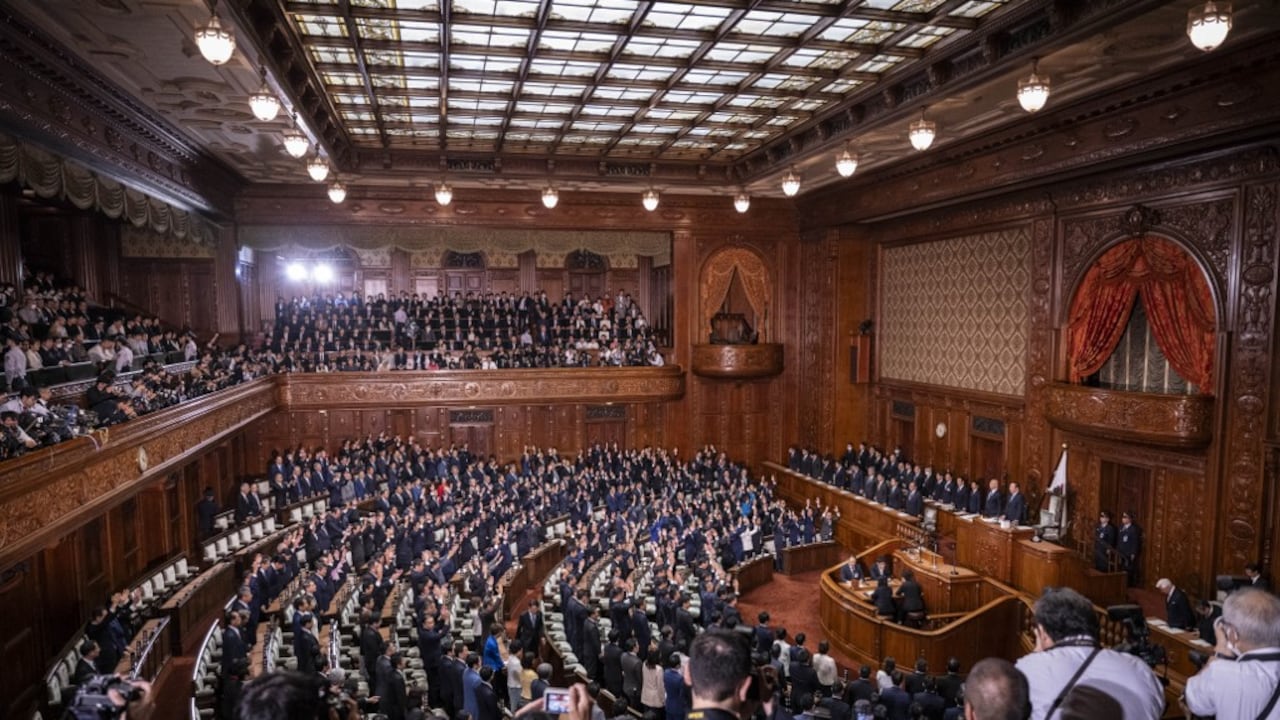
It is 2026, and the Japanese Diet—the engine room of one of the world's most advanced economies—is still struggling with the basics. Specifically, it is struggling with plumbing.
Recently, 58 female lawmakers submitted a petition to the lower house committee. Their demand wasn't for radical legislative reform or a shift in fiscal policy, though those are desperately needed. They asked for more toilets.
To understand why this is a story, you have to look past the headlines. It isn’t just about the lines outside the restroom before a plenary session. It is about a structure, both physical and political, that was designed for a demographic that barely resembles the Japan of today.
A Time Capsule From 1936
The National Diet Building is, objectively, a marvel of architecture. Finished in 1936, it stands as a testament to pre-war engineering. But it is also a time capsule. When it was built, women didn't even have the right to vote in Japan—that wouldn't happen for another decade.
The building wasn't designed for gender parity because the concept wasn't on the table. Today, the lower house has 465 seats. After the last election, a mere 68 of those are held by women. While that number is higher than it used to be, it is still a glaring minority.
When you pack nearly 70 women into an environment built for a 99% male legislature, the infrastructure fails. Currently, the lower house facility boasts 12 men's restrooms with 67 stalls, but only nine women's facilities with 22 cubicles. It is math, not opinion, that makes this untenable.
The Cost Of Institutional Inertia
We love to talk about "innovation" and "modernization" in Tokyo boardrooms. Yet, the heart of the government is effectively saying that women are guests in a building designed for men.
This is not just about the inconvenience of waiting in line. It’s about the subtle, constant signal that the workplace was not built for you. When you have to leave your workstation, miss part of a debate, or sprint across the building because there isn't a facility in your wing, it impacts your ability to perform your job.
If you want more women in politics, you need to provide the environment where they can actually function. It sounds obvious, but it is clearly missing.
Beyond The Plumbing
The toilet petition is a symptom of a much larger, more calcified problem. We are seeing a conversation about "gender equality" that remains stuck on the surface.
Prime Minister Sanae Takaichi, Japan's first female leader, faces a political landscape that is still deeply conservative. Even with a female PM, the proportion of women in the cabinet remains low, and policy positions on gender issues have, by some measures, shifted toward the status quo rather than toward radical inclusion.
The issue isn't that women aren't capable or aren't willing to run. It's that the barriers are everywhere. They are in:
- The Schedule: Legislative sessions that don't accommodate caregiving responsibilities.
- The Culture: Old-school networking that happens in late-night sessions where women are often excluded.
- The Optics: Focusing on "maiden names" and "toilet stalls" rather than addressing the systemic lack of female leadership in the LDP and other major parties.
The Real Talk About Representation
We need to stop framing these issues as "special requests." Adding two more toilets is not a feminist victory; it is a basic facilities upgrade that is roughly 80 years overdue.
If we want to see more than 14.6% female representation in the lower house, we need to stop treating women's participation as an accessory to the main event.
If you are a voter, stop looking for candidates who talk about "tradition" as a reason to maintain stagnant infrastructure. Look for those who understand that a 21st-century democracy cannot run on 1930s logistics.
Equality isn't just about quotas or slogans. It’s about being able to show up to work, do your job, and not have to petition for the right to use the restroom while you’re there. Until the Japanese parliament realizes that its physical space needs to reflect its modern aspirations, it will continue to be a relic of a past that most of the country has already outgrown.
It is time to renovate the building, and it is past time to renovate the politics.
Everything You Need to Know About Women in Japanese Politics
This video provides additional context on the structural and cultural challenges facing female lawmakers in Japan, illustrating the broader fight for parity beyond just the recent restroom petition.