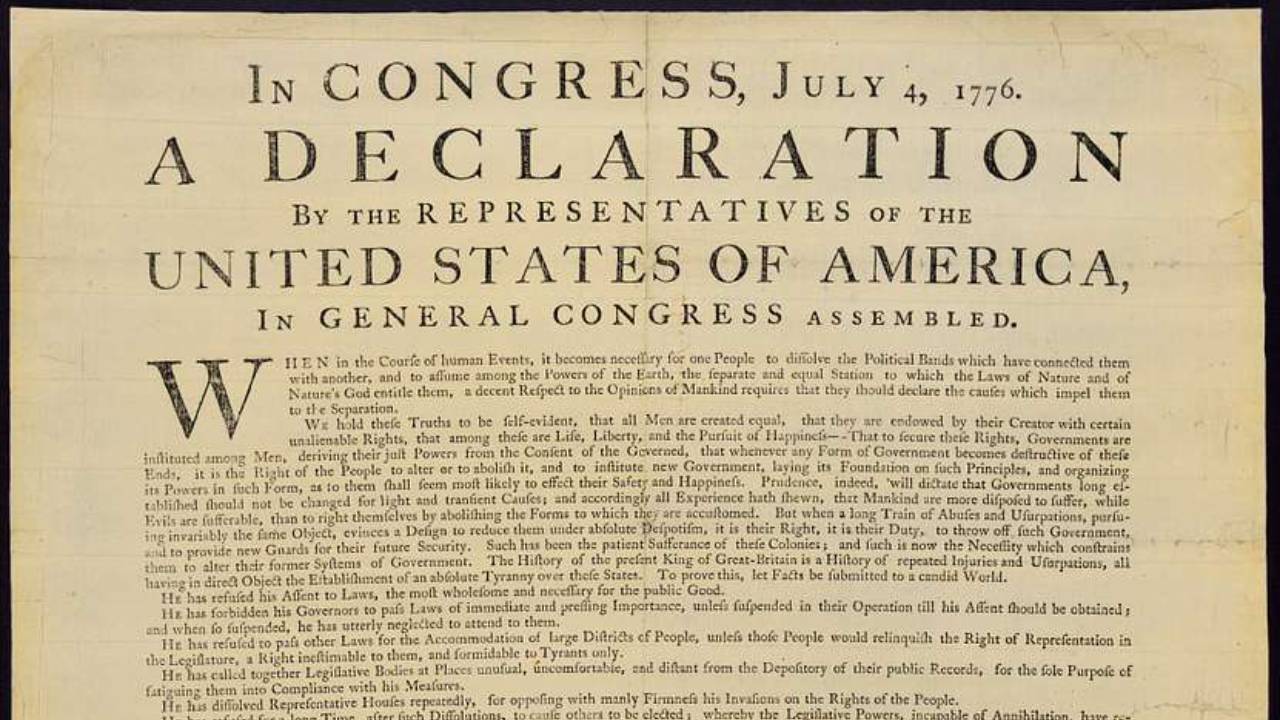
History has a funny way of hiding in plain sight. For nearly 250 years, a pristine 1776 copy of the US Declaration of Independence sat inside a dusty box in London. Nobody knew it was there. To British officials, it wasn't a world-altering document. It was just paperwork seized from a captured rebel ship.
A volunteer archivist named Michael Scurr found it while sorting through uncatalogued Royal Navy letters at the UK National Archives. He noticed a document listed simply as "another paper" in an old inventory. When he unfolded it, the word "Declaration" stared back at him.
This isn't just another old piece of paper. It's an Exeter printing, produced in New Hampshire between July 16 and 19, 1776. It is one of only 11 surviving copies of its kind in the entire world. More importantly, it's the only original July 1776 copy ever found outside the United States.
The discovery answers a massive question about the American Revolution. How did the ideas of 1776 actually travel? It turns out they went to sea.
The Secret Privateer Mission of the Dalton
We usually picture the Revolutionary War through the lens of land battles. We think of Valley Forge, frozen feet, and George Washington crossing the Delaware. We forget about the ocean.
The newly discovered document belonged to the crew of the Dalton, an 18-gun American privateer ship out of Newburyport, Massachusetts. Privateers weren't regular navy. They were privately owned, armed merchant vessels authorized by the Continental Congress to attack British shipping and disrupt trade.
Captain Eleazer Johnson commanded the Dalton. Before he set sail across the Atlantic, he stopped in Portsmouth, New Hampshire, to recruit more men. That's likely where he picked up this copy of the Declaration of Independence.
Why carry a treasonous document on an armed raid? Amanda Bevan, a legal records expert at the National Archives, believes Captain Johnson read the text aloud to his 120-man crew on deck. These sailors weren't just fighting for money or out of personal grievances. Reading the document gave them a shared ideal. It told them exactly what they were risking their lives for on the open ocean.
The Dalton's mission cut short on Christmas Eve, 1776. Off the coast of Portugal, a massive 64-gun British warship, the HMS Raisonnable, spotted the privateer. After a brutal seven-hour chase, Captain Thomas Fitzherbert captured the American vessel.
How British Bureaucracy Saved American History
When the British military captured a enemy ship, they didn't just throw everything overboard. They kept meticulous records. Every scrap of paper on the Dalton had to be presented to the Admiralty Court in London so the British captain and crew could claim their legal share of the captured ship's value.
The British seized the Dalton's official commission, which happened to be personally signed by John Hancock. They also grabbed the ship's rules of engagement. They filed those major legal documents away properly.
The copy of the Declaration of Independence received different treatment. Captain Fitzherbert likely recognized its political importance, but the court didn't care about a piece of colonial propaganda. They labeled it "another paper" and tucked it inside a bundle of routine captain's letters.
The British bureaucracy did something incredible by treating the document with indifference. They preserved it. For over two centuries, the paper sat untouched in stable conditions, shielded from light, moisture, and handling.
The National Archives recently put the document through rigorous scientific testing. Heritage scientist Marc Vermeulen used raking light photography to map the original fold lines from 1776. Under a microscope, the handmade paper shows distinct yellow and blue fibers. Aside from a small tear that archivists repaired with Japanese paper and wheat starch paste, the text remains perfectly legible. You can read the words "life, liberty and the pursuit of happiness" as clearly as the day it came off the press.
What This Discovery Means for Historians
Nicholas Guyatt, a professor of North American history at the University of Cambridge, points out that the document's survival highlights a massive blind spot in how we study the revolution. To the British in 1776, the Declaration wasn't sacred. It was just a piece of rebel text from a colony they fully expected to subdue.
This find also proves that our understanding of the American Revolution isn't set in stone. Even as the US celebrates its 250th anniversary, major pieces of the puzzle are still waiting to be uncovered in overlooked archives.
If you want to track down historical discoveries yourself, or explore the deep records of this era, you don't have to guess where to look.
- Check out the UK National Archives Revolution 250 exhibition, where this document will eventually go on public display.
- Look into the Prize Papers Project, a massive academic collaboration between the UK National Archives and the University of Oldenburg that is currently digitizing millions of documents seized from captured ships between 1652 and 1815.
- Visit the Museum of the American Revolution in Philadelphia to see how privateers and maritime warfare shaped the outcome of the war.
History isn't finished. Millions of pages of wartime correspondence remain unread by modern eyes. The next major revelation about our past is likely sitting in a cardboard box right now, waiting for someone to clear off the dust.