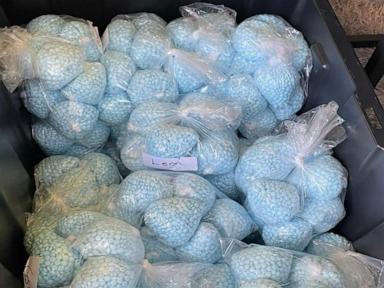
Federal agents stood by and watched as hundreds of thousands of lethal fentanyl pills flooded into local neighborhoods. They knew the risks, they knew the pipeline, and they let the drugs move anyway.
Now, New Mexico Governor Michelle Lujan Grisham is pushing back with an unprecedented demand for a state-level criminal investigation into the Drug Enforcement Administration.
This isn't a minor policy disagreement or routine bureaucratic friction. It is a direct legal assault by a state executive against a federal law enforcement entity operating within her borders. The move follows a damning Associated Press investigation revealing that between 2023 and 2025, DEA agents repeatedly allowed massive shipments of fentanyl to flow uninterrupted through New Mexico. The agency's justification was standard drug-war doctrine: leave the lower-level shipments alone to build a larger, more comprehensive case against international cartel kingpins.
But local communities paid the price for that gamble. The Governor made her stance perfectly clear, stating that New Mexican lives are not the federal government's cost of doing business. She has officially directed the state Attorney General to determine if federal operatives violated New Mexico state law.
The Broken Logic of Letting Drugs Walk
The strategy deployed by the DEA relies on tracking contraband rather than seizing it immediately. In law enforcement circles, variations of this tactic are known as controlled deliveries or letting drugs walk. The core theory makes sense on a white board. If you bust a low-level mule carrying 10,000 pills, the cartel loses a tiny fraction of revenue and replaces them tomorrow. If you follow that mule to a warehouse, you might take down a regional distribution cell. If you follow the money up the chain, you can theoretically dismantle the entire enterprise.
In practice, this theory breaks down completely when applied to synthetic opioids. Fentanyl isn't marijuana or cocaine. It is cheap to produce, incredibly compact, and lethal in microgram doses.
Internal government records from the investigation paint a terrifying picture of how this strategy played out on the ground. In one documented incident from 2023, DEA agents actively surveilled a delivery of 74,000 fentanyl pills at a mobile home park in Albuquerque. Instead of moving in, securing the area, and taking the poison off the market, agents watched and allowed the shipment to scatter into the surrounding community.
The DEA insists its actions were legal and reasonable under existing Department of Justice guidelines. Agency spokespeople have argued that immediate interdiction isn't always possible or practical when pursuing high-value targets. Former U.S. Attorney for New Mexico, Alex Uballez, defended the approach by pointing out limited resources and stating his belief that dismantling entire trafficking networks yields a greater long-term impact than stopping every isolated street transaction.
A Steep Rise in Local Casualties
While federal prosecutors look at long-term statistics and organizational charts, local families are burying their children. The timeline of this DEA operational strategy overlaps with a brutal surge in overdose fatalities across New Mexico.
National trends show a 14% decline in overdose deaths over the last year. New Mexico went in the exact opposite direction, experiencing a devastating 21% spike.
It is incredibly difficult to tie a specific death to a specific unseized shipment. However, adding hundreds of thousands of highly potent pills directly to local street supplies undeniably exacerbated the crisis. The strategy fundamentally contradicts the federal government's own public safety campaigns. For years, the DEA has pushed its "One Pill Can Kill" message, warning citizens that a microscopic dose of fentanyl can end a life instantly. For an agency to broadcast that warning while simultaneously permitting massive crates of those exact pills to enter residential zones strikes local advocates as hypocritical and dangerous.
Families affected by fentanyl addiction feel betrayed by the institutional choices made behind closed doors. When the government decides that short-term community safety can be sacrificed for a theoretical long-term investigative win, it loses the trust of the people it is sworn to protect.
The Sovereignty Battle Over Federal Immunity
Can a state governor actually prosecute federal agents for doing their jobs?
This is the central legal question hanging over New Mexico's move. Under the Supremacy Clause of the U.S. Constitution, federal law generally trumps state law. Federal employees also enjoy a doctrine known as qualified immunity, which shields them from personal liability and state-level prosecution as long as their actions don't violate clearly established statutory or constitutional rights.
However, that immunity isn't an absolute shield for reckless behavior. If federal agents knowingly violate internal Department of Justice directives designed to protect human life, their legal protection begins to erode. Whistleblower advocacy groups, including Empower Oversight, have already stepped in to represent insiders who raised the alarm on these specific DEA operations. They are calling for immediate oversight reviews by both the Senate Judiciary Committee and the Justice Department’s Office of the Inspector General.
If the New Mexico Attorney General uncovers evidence that agents acted with extreme negligence or actively bypassed mandatory public safety guardrails, a state-level indictment could follow. Even if federal courts ultimately dismiss the charges based on jurisdictional supremacy, the resulting legal battle will force a massive public reckoning over how federal agencies conduct the drug war inside sovereign states.
Real Steps Toward Reform and Accountability
Fixing this systemic failure requires immediate, concrete actions rather than political grandstanding. The focus must shift away from high-stakes gambling with public health and move toward immediate harm reduction and strict operational transparency.
- Mandatory Interdiction Rules: Federal law enforcement guidelines must be updated to mandate the immediate seizure of synthetic opioids whenever they are located, removing the discretionary power to let lethal doses walk into communities.
- Independent State Oversight: States must establish independent monitoring systems to track federal law enforcement operations within their borders, ensuring local public safety takes precedence over federal tactical theories.
- Fentanyl Specific Protocols: Treat synthetic opioids differently than agricultural drugs; because of their low lethal threshold, traditional long-term tracking strategies should be banned for fentanyl and its analogues.
- Resource Reallocation: Shift federal funding away from multi-year kingpin investigations that require community sacrifice and redirect those assets to immediate border interdiction and local treatment infrastructure.
The current strategy treats local neighborhoods as acceptable collateral damage in a macro-level chess match against the cartels. By demanding a criminal probe, New Mexico is drawing a hard line and forcing federal agencies to respect local sovereignty and human life. The days of letting poison hit the streets in the name of a bigger bust must come to an end.