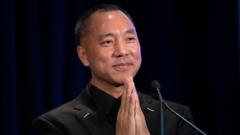
Guo Wengui wasn't just another billionaire behaving badly. When a federal judge in Manhattan handed down a 30-year prison sentence on Monday, it ended one of the wildest white-collar crime sprees in American history.
Many people still believe Guo was a legitimate political dissident targeted by Beijing. That's exactly the illusion he spent hundreds of millions of dollars to build. In reality, he ran a massive, multi-tiered financial scam that fleeced his own online followers out of more than $1 billion.
He didn't weaponize politics to protect himself. He weaponized it to buy a 152-foot superyacht, a Central Park penthouse, and a fleet of luxury sports cars.
The $1 Billion Illusion Driven by Anti-CCP Rhetoric
If you followed Guo online, you knew him as Miles Guo or Ho Wan Kwok. He arrived in the United States in 2017 after fleeing China under a cloud of corruption allegations. He quickly rebranded. He became a loud, charismatic critic of the Chinese Communist Party (CCP).
For thousands of Chinese immigrants and diaspora members, Guo looked like a savior. He promised to overthrow the Chinese government. He spoke their language. He understood their fears.
Then he started asking for money.
Guo created a network of entities, including GTV Media Group, the Himalaya Farm Alliance, and a supposed cryptocurrency called the Himalaya Exchange. He convinced his followers that investing in these projects was a dual-purpose move. They would get rich, and they would fund the fight for a democratic China.
It was a lie.
The U.S. Attorney’s Office proved that Guo used these businesses as a personal piggy bank. Instead of building media empires or revolutionary technology, the funds poured directly into his extravagant lifestyle.
The Devastating Human Cost of the Fraud
A common mistake is looking at white-collar crime as victimless. It's easy to assume that anyone with money to invest can afford to lose it.
The letters sent to U.S. District Judge Analisa Torres tell a completely different story.
During the sentencing, the judge read statements from everyday people who lost their entire life savings. These weren't institutional investors. They were working-class individuals who trusted Guo because of his political stances.
One victim, Wei Chen, testified openly during the seven-week trial in 2024. She told the court that Guo's fraud destroyed her life and her family. Families tore themselves apart over these investments. People experienced extreme anxiety and shame.
Guo didn't care. Judge Torres pointed out that Guo showed zero remorse and even encouraged his remaining followers to harass and threaten critics who tried to expose him.
Beside the 30-year prison term, the court hit Guo with an $889 million forfeiture order. He will have to give up the assets he bought with stolen money, but for many victims, the financial wreckage is already permanent.
The Steve Bannon Connection and the Far-Right Alliance
Guo knew he needed American institutional cover to make his dissident persona believable. He found it in right-wing political figures, most notably former Donald Trump adviser Steve Bannon.
The two became incredibly close. In 2020, they stood together on a boat and announced the "New Federal State of China," a shadow government designed to replace the CCP.
That alliance led to bizarre moments. When federal agents arrested Bannon in August 2020 for an unrelated fraud scheme involving border wall donations, they found him on Guo’s luxury yacht off the coast of Connecticut.
Even as Guo sat in a Brooklyn jail awaiting his fate, he kept trying to associate with high-profile names. He even tried to intervene in the legal case of Sean Combs, who happened to be housed in the same detention center.
Guo’s defense lawyers argued right up to the end that a heavy sentence would validate Beijing's global campaign against dissidents. They claimed the CCP orchestrated his downfall by manipulating U.S. institutions.
The court didn't buy it. Assistant U.S. Attorney Ryan Finkel cut through the political theater during the hearing. He made it clear that Guo is not a political activist. He is a thief who got caught.
What to Watch Next in the Fallout
The saga doesn't end with Guo going to prison. If you want to track where this story goes next, watch these specific areas.
First, look at the liquidation of his assets. The U.S. government is actively trying to claw back the $889 million. This means the high-profile auctions of his Central Park penthouse, luxury cars, and custom furnishings will hit the market soon.
Second, monitor the remaining leadership of his organizations. His chief of staff, Yvette Wang, was already sentenced to 10 years in prison last year for her role in the conspiracy. Federal investigators are still looking at the secondary figures who helped keep the Himalaya Exchange running.
Finally, keep an eye on how the Chinese diaspora reacts. Many of Guo's hardcore supporters still gathered outside the Manhattan courthouse, claiming the American justice system failed. The division he created within the anti-CCP movement will take years to heal.