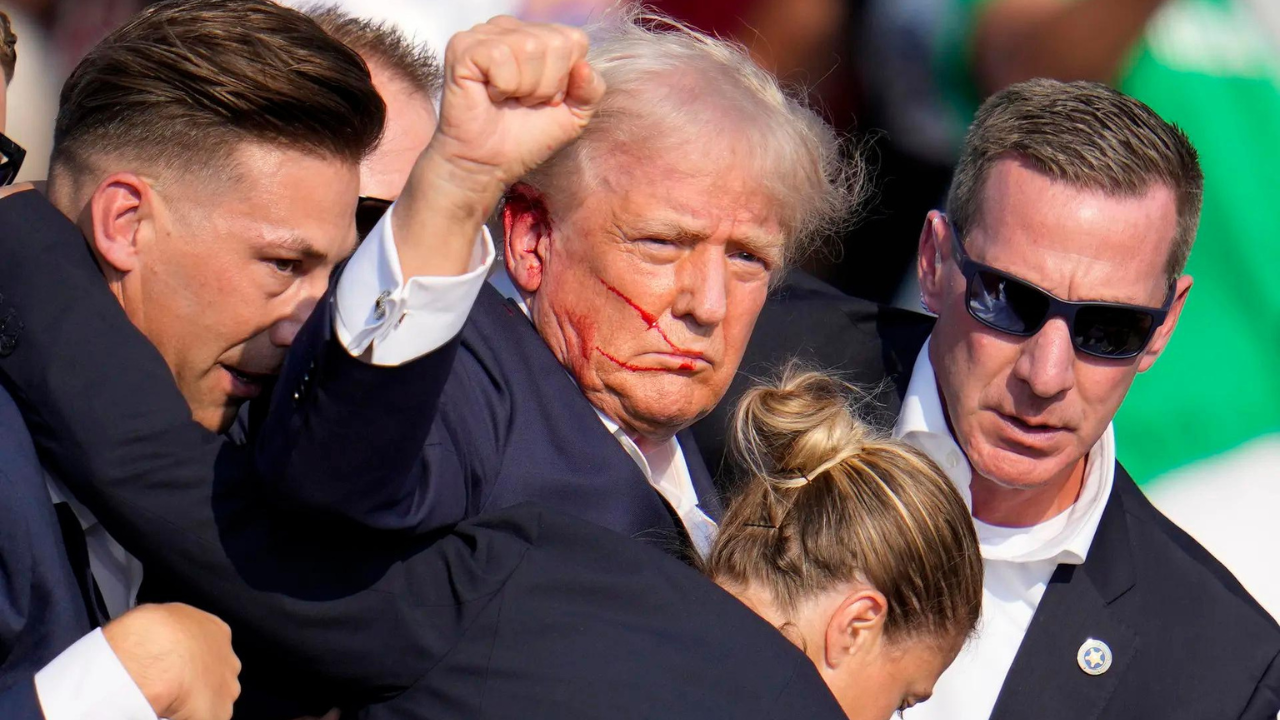
You think you know exactly how close former President Donald Trump came to losing his life on that sweltering July day in Butler, Pennsylvania. You watched the footage. You saw the frantic scramble of agents. You heard the crack of the rifle shots. But the real story isn't just about a lone gunman on a roof. It's about an elite federal agency entirely blindfolded by its own bureaucratic incompetence.
A scathing final report from the Department of Homeland Security Office of Inspector General dropped. This document, labeled OIG-26-13, exposes an astonishing breakdown in basic communication. The Secret Service didn't just have a bad afternoon. They completely tuned out the people trying to save lives.
Most media coverage fixates on a few seconds of terror. That misses the point entirely. The disaster started hours before a single trigger was pulled. It wasn't a sophisticated plot that breached the perimeter. It was a failure of basic checklists, flat tires in the technical department, and a shocking refusal to talk to local cops.
The Shocking Reality of 102 Missed Alerts
Local police officers were screaming into their radios for chunks of the afternoon. They were actively tracking a highly suspicious individual wandering the grounds with a rangefinder. They shared real-time descriptions. They noted his strange behavior.
The Secret Service heard exactly zero of those radio transmissions.
Specifically, the agency missed 102 separate local police radio calls regarding Thomas Crooks. Think about that number. One hundred and two chances to intercept a killer before he climbed a ladder. One hundred and two moments where someone could have told the protect detail to keep Trump backstage.
Why were they completely deaf to these updates? The Secret Service failed to set up a joint communications room with local law enforcement. It is security protocol 101 for a high-level event. Instead of a unified command center where federal and state officials sit side-by-side, the agency isolated itself.
Because of this self-imposed isolation, information trickled in through a pathetic handful of manual updates. The Inspector General found that the Secret Service received a mere five phone calls and three text messages about Crooks during the critical window. That is it. While local officers were flooding the airwaves with frantic searches, the elite federal protective detail relied on text messages. This communication vacuum directly ensured that Trump took the stage without a single warning about an active threat lurking 150 yards away.
The Inoperable Anti Drone Shield
The failures in the air were just as bad as the failures on the ground. Hours before the shooting occurred, Thomas Crooks brought a drone to the site. He launched it. He flew it over the rally grounds for nearly nine minutes, mapping out lines of sight and studying the layout. He ran an open aerial reconnaissance mission right under the nose of the premier protective agency in the world.
The Secret Service possessed an advanced counter-drone system on-site designed to prevent exactly this. The system sat there completely useless.
According to the watchdog report, the counter-drone equipment was left in the hands of a single operator who lacked proper training. This operator didn't perform basic pre-event diagnostic checks on the machinery. When the system inevitably malfunctioned, the operator had no idea how to fix it quickly. He spent hours troubleshooting the hardware, effectively leaving the skies wide open for Crooks to gather intelligence. By the time the equipment worked, the killer already had his map.
Giving Away the High Ground
You don't need a degree in military strategy to understand that an open rooftop with a direct line of sight to a stage is a hazard. The Secret Service actually identified the American Glass Research complex as a significant security risk during their initial site walkthroughs. They knew it looked right down at the podium.
Yet they did nothing to secure it.
The Pennsylvania State Police explicitly shared their tactical plans with the Secret Service days before the rally. Those plans clearly showed that the perimeter outside the immediate fence line, including the building Crooks used, was unsecure and undermanned. Local law enforcement even warned federal agents that they lacked the sheer manpower to lock down that complex properly.
The agency ignored the warning. They didn't deploy extra personnel to cover the blind spot. They didn't use readily available equipment, like heavy vehicles or banners, to physically block the line of sight between that roof and the speaker's platform. They left an open window and assumed nothing would crawl through it.
An Insulting Lack of Internal Accountability
When an organization fails this catastrophically, you expect a swift housecleaning. You expect heads to roll. Instead, we witnessed a masterclass in federal face-saving and finger-pointing.
A concurrent final report from the Senate Homeland Security Committee, spearheaded by Senator Rand Paul, highlights a deeply frustrating reality. The Secret Service has not fired a single human being responsible for the planning or execution of the Butler rally. Not one.
Instead, they handed out slap-on-the-wrist disciplinary actions to six employees. Some of these individuals received brief suspensions without pay, ranging from 10 to 42 days. In two cases, leadership actually stepped in to reduce the punishments originally recommended by investigators. This lack of internal accountability sends a terrible message to rank-and-file agents and the public alike. When a former president gets shot in the ear on live television due to systemic negligence, a one-month suspension is an insult to the concept of public safety.
What Needs to Change Right Now
We can't change what happened in Butler, but the security apparatus must evolve immediately to prevent a repeat performance. Relying on the agency to grade its own homework clearly isn't working. True operational reform requires shifting away from old habits.
First, unified communication structures must be mandatory. No federal protective division should ever operate on an isolated loop when local assets are on the ground. A physical joint communications desk must be established at every single event site, period.
Second, technical equipment requires dedicated, expert teams. You can't just hand a million-dollar counter-drone system to an undertrained agent and hope for the best. Technology is only as good as the person running it. Specialized technician crews need to handle drone defenses, and they must sign off on mandatory diagnostic testing hours before an event begins.
Finally, physical line of sight issues cannot be left to chance or verbal agreements with local departments. If a building overlooks a stage and cannot be manned, the view must be blocked mechanically. No exceptions. The Secret Service claims it is updating its manuals and establishing new aviation structures. Manuals don't save lives. Aggressive tactical adjustments and real consequences for failure do.
This video breakdown provides a detailed look at the investigative findings, highlighting how structural disorganization and planning gaps led to these severe security blind spots.