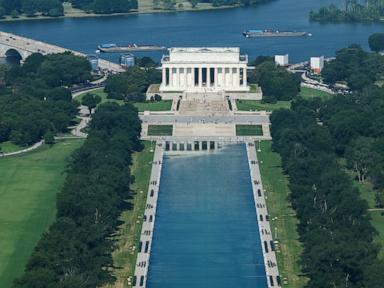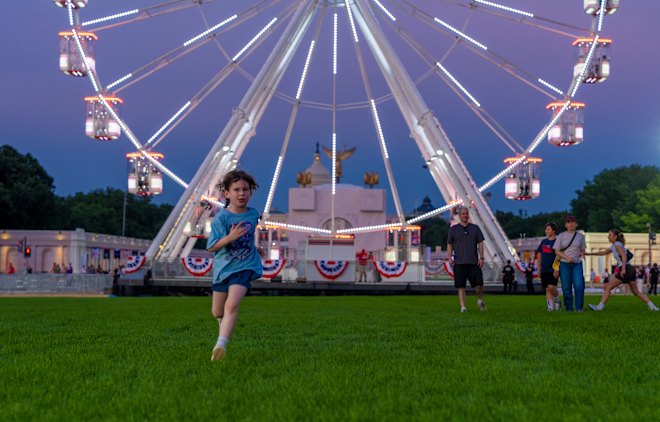
The National Mall in Washington, D.C. usually spends its summers hosting the Smithsonian Folklife Festival or accommodating tourists shuffling between monuments. Right now, it looks like a cross between a county carnival, a heavily armed military compound, and a high-stakes political rally.
This is the Great American State Fair, the flagship event of President Donald Trump’s Freedom 250 initiative, designed to mark the 250th anniversary of American independence.
If you read the mainstream headlines, you'll hear it's either an empty, post-apocalyptic wasteland or a terrifying authoritarian rally. The truth is much weirder. It’s a surreal mix of genuine, small-town Americana and aggressive partisan branding. I walked the grounds to see what’s actually happening behind the high security fences.
Here is what most people are getting wrong about it.
The Partisan Boycott is Real But Oddly Distributed
The biggest narrative surrounding the fair involves the missing states. Critics claim everyone is bailing on the President. It's true that 11 states, all led by Democratic governors, flatly refused to build pavilions. Connecticut, Illinois, Massachusetts, North Carolina, Maine, Oregon, Washington, and Pennsylvania are completely absent.
Massachusetts Governor Maura Healey complained about the federal government charging states up to $200,000 in taxpayer money just to secure space and pay for logistics. Oregon cited growing partisan anxiety.
Walk through the actual event space and you will notice that the organizers tried to paper over these gaps. The Freedom 250 task force promised all 56 states and territories would be represented. If a state government boycotted, organizers just found a private tourism board, a local business, or a conservative activist group to set up a tent anyway.
You don't get the official state seal of Connecticut, but you can still buy local products or talk to representatives who stepped in to fill the void. Truth Social even has its own prominent pavilion right in the middle of the grounds. It makes the entire layout feel less like a formal World's Fair and more like a highly curated corporate trade show.
High Prices and Modest Crowds
The internet loves to post photos of empty walkways to prove the event is a total failure. That is a stretch, but attendance has definitely been modest during the humid weekdays.
Getting inside is a chore. Tall security fences encircle the entire National Mall, forcing visitors to walk more than a mile from transit hubs like the Federal Triangle station just to find an open security gate. Once you get past the metal detectors, the crowds thin out quickly.
The longest line by far is for the 110-foot Ferris wheel, which offers great views of the Capitol building. Beyond that, people congregate where there is shade.
Then there's the food. State fairs are famous for cheap, greasy eats. Not this one. A single jumbo turkey leg will set you back $23. Funnel cakes and deep-fried Oreos are priced at premium stadium rates. Admission to the fairgrounds is completely free, but you will pay a steep premium the moment your kid asks for a snack or a drink.
From Agriculture to Cult of Personality
The programming shifts violently depending on which tent you step into. Some pavilions stick to classic, harmless state pride. Mississippi reminds everyone they gave the world Elvis Presley. Nebraska features a massive truck simulator and a plaque bragging about inventing modern center-pivot irrigation systems. Puerto Rico is running salsa dancing tutorials on a loop. Indiana set up a mini-golf station, and Montana has a mock dinosaur bone-digging pit for kids.
Turn a corner, though, and the tone shifts instantly. Right across from the Ferris wheel sits a scaled-down replica of Trump’s proposed victory arch, a monument planned for Memorial Circle near Arlington National Cemetery.
The live entertainment has faced major issues. Musicians like Martina McBride, Young MC, and The Commodores backed out of scheduled performances at the last minute. They claimed they were originally told the event was strictly nonpartisan, only to realize the setup was heavily politicized.
The administration adjusted quickly. At the opening ceremonies, Transportation Secretary Sean Duffy openly mocked the artists who canceled, shouting out the military bands who stepped in instead.
The schedule now explicitly caters to the base. There are MAHA Mondays, dedicating entire blocks of programming to the "Make America Healthy Again" movement led by Health Secretary Robert F. Kennedy Jr. and featuring appearances by CMS Administrator Dr. Mehmet Oz.
What This Means for the Fourth of July
Don't mistake the quiet weekday crowds for a total flop. The entire event is built to crescendo on the Fourth of July.
Trump has bypassed the traditional, bipartisan America250 commission in favor of his own Freedom 250 task force. The result is a fractured celebration. While Washington, D.C. hosts this heavily politicized fair, a completely separate, star-studded event hosted by Queen Latifah and featuring Chris Stapleton is happening simultaneously in Los Angeles. The two organizing committees don't talk to each other.
The administration is betting everything on the holiday weekend. Trump is billing the upcoming fireworks show as a spectacle ten times larger than any display in American history. Massive crowds of supporters are already arriving in the capital, sporting matching red apparel.
If you plan to visit the National Mall before the fair closes on July 10, skip the politically charged weekend rallies unless you want to be trapped in a campaign environment. Stick to the early morning hours on a weekday. You'll avoid the worst of the security lines, get a seat on the Ferris wheel without a two-hour wait, and can appreciate the weird, fragmented exhibits of American culture in relative peace. Just eat lunch before you pass the security gates unless you want to spend a fortune on a turkey leg.