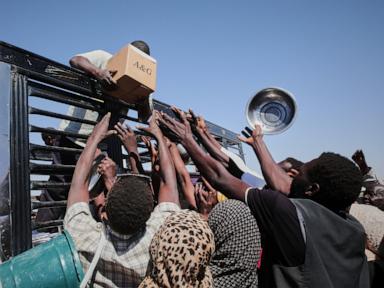
The warning signs coming out of central Sudan aren't just flashing amber anymore. They're bright red. When the United Nations human rights chief stands before the Human Rights Council in Geneva and states clearly that "this is not a drill," it's time to stop looking away. Sudan is in its fourth year of a brutal, grinding civil war, and the strategic city of el-Obeid is sitting right in the crosshairs of what looks like the next major humanitarian slaughter.
We've seen this exact playbook before. We watched it happen in El Fasher. We saw it unfold at the Zamzam displacement camp in North Darfur. Now, the same terrifying patterns are repeating in North Kordofan. The paramilitary Rapid Support Forces (RSF) are massing troops, tightening a historical chokehold, and raining down drone strikes on a city packed with half a million people. UN High Commissioner for Human Rights Volker Türk just sounded a literal red alert, telling world leaders that their phones should be running hot with ideas to stop this impending disaster.
But warnings don't stop bullets, and they certainly don't stop drones. If the international community treats this as just another entry in a long line of tragic press releases, el-Obeid will fall, and the human cost will be astronomical.
The Chokehold on North Kordofan
To understand why el-Obeid matters so much, you have to look at a map. It isn't just another town caught in the crossfire. It's the capital of North Kordofan state and a massive logistical hub. It sits at the geographic and economic crossroads of Sudan, connecting Khartoum to the Darfur region and acting as the main gateway for humanitarian aid flowing into the broader Kordofan territory. Whoever controls el-Obeid effectively controls the movement of goods, food, and weapons across central and western Sudan.
The civilian population here has already endured hell. For 18 long months, the city has been trapped in siege-like conditions. In February 2025, the Sudanese Armed Forces (SAF) managed to break a year-long blockade imposed by the RSF. That provided a brief, desperate breathing room. But it didn't last. The RSF has spent the months since launching relentless fresh offensives to reestablish that suffocating siege from multiple directions.
Right now, the RSF and its allied militias are building up massive troop numbers right outside the city gates. They aren't just waiting around. They're actively softening the target. Between June 6 and June 28 alone, the UN human rights office recorded at least 15 drone strikes in and around el-Obeid. Those strikes killed at least 45 civilians and wounded 41 others. Think about those numbers. These aren't military casualties. These are families, shopkeepers, and local workers getting blown apart in residential neighborhoods.
The Lethal Rise of Cheap Drones
One of the most terrifying aspects of this specific escalation is how the nature of the warfare has shifted. This isn't just infantry clashes and artillery duels anymore. The skies over el-Obeid are filled with drones. UN officials have pointed out that the growing use of these remote weapons is making the conflict far more unpredictable and deadly for regular people.
The strikes are highly targeted, but not in a way that protects civilians. Instead, they're hitting the very infrastructure required to keep half a million people alive. Fuel stations have been systematically targeted. Transport trucks carrying essential goods have been incinerated. When you blow up a city's fuel supply and its transport network, you aren't just fighting an army. You're cutting off the water pumps, the hospital generators, and the food distribution networks.
Clean water shortages in el-Obeid have reached a genuinely catastrophic point. Food is scarce, prices have skyrocketed, and medical care is basically nonexistent. Over the past weeks, a humanitarian aid worker was among those killed by a drone strike in a residential area. When the people trying to feed the population are getting targeted and killed, the entire survival apparatus collapses.
The Shadow of External Actors
Let's be completely honest about how this war stays alive. Neither the Sudanese Armed Forces nor the Rapid Support Forces could keep up this relentless pace of destruction without outside help. They don't manufacture these sophisticated drones themselves. They don't have endless stockpiles of advanced artillery shells sitting in Sudanese warehouses.
They get them from external sponsors who are perfectly happy to watch Sudan burn if it secures their geopolitical interests.
Advocacy groups and civil society organizations have been yelling into the void about this for years. The UN Security Council and top diplomats are finally dropping the polite language and pointing fingers. Human Rights Watch and various international experts have explicitly called out the insidious role of external actors, most notably the United Arab Emirates (UAE), in allegedly fueling the RSF's military campaign. While the UAE denies providing military support, credible investigative reports and UN documentation suggest a steady flow of weapons and logistics moving across borders into RSF territory.
On the flip side, the regular Sudanese army has sought its own foreign backers, drawing in regional powers and creating a proxy war that gets more complicated by the day. Tensions are boiling over the borders with Ethiopia and Chad, threatening to drag neighboring states directly into the meat grinder. This external interference is the oxygen that keeps the fire burning. If world leaders actually want to answer Volker Türk's red alert, they have to stop looking at Sudan in a vacuum and start squeezing the supply chains of the countries supplying the weapons.
Failing the Lessons of El Fasher
The most frustrating part of this unfolding disaster is that we have the ultimate blueprint of what happens next if the world does nothing. Just look at El Fasher and the Zamzam IDP camp in North Darfur. The global community watched the RSF surround those areas. We listened to the exact same warnings from UN officials. We saw the same diplomatic hand-wringing.
And then we watched the massacres happen anyway.
We saw summary executions. We saw widespread, systemic sexual violence used as a deliberate weapon of war against women and girls. We saw neighborhoods burned to the ground and ethnic targeting on a massive scale. The war has already killed at least 59,000 people across the country—though most experts agree that's a massive underestimate due to the lack of tracking on the ground. It has displaced 13 million people, creating the largest displacement crisis on earth. Over 30 million people need immediate humanitarian assistance, and large swathes of the country are officially sliding into a man-made famine.
If el-Obeid suffers a full-scale ground offensive, the hundreds of thousands of civilians trapped inside have nowhere left to run. The surrounding areas are already overstretched, foodless, and dangerous. A major battle inside the city will trigger an immediate, bloody exodus into a desert of starvation.
What Needs to Happen Right Now
We don't need another generic statement expressing "grave concern." We don't need another round of toothless resolutions that the warring generals simply laugh at. If there is any hope of averting an absolute slaughter in el-Obeid, the international strategy has to shift immediately toward concrete, high-pressure actions.
First, the UN Human Rights Council must grant immediate backing and expanded resources to the Independent International Fact-Finding Mission for Sudan. Investigators need the logistical teeth to track, identify, and name every single commander responsible for ordering drone strikes on residential areas and cutting off civilian water supplies. Accountability can't wait until a formal peace treaty is signed five years from now. The generals need to know, in real-time, that their names are going on international arrest warrants.
Second, the diplomatic focus has to pivot directly to the enablers. The "Quad" group—the United States, Saudi Arabia, the UAE, and Egypt—along with the African Union and European partners, must exert direct, heavy economic and political pressure on the supply lines feeding the RSF and SAF. If a country is funneling drones or cash into this conflict, they need to face tangible diplomatic consequences and targeted sanctions. You can't claim to be a partner in global stability while simultaneously financing a human rights catastrophe.
Finally, there must be a hyper-coordinated push to secure protected humanitarian corridors into el-Obeid. The UN Secretary-General's personal envoy for Sudan, Pekka Haavisto, recently pressed RSF leader General Mohamed Hamdan Dagalo (Hemedti) on this exact issue. Hemedti claimed his intention isn't to harm civilians and that he wants to protect aid corridors. The international community must hold him to that statement with aggressive, public monitoring. Talk is cheap when drone strikes are hitting food trucks. Aid organizations must be given immediate, unhindered, and physically protected access to deliver food, fuel, and medical supplies to the city's population before the ground offensive begins.
The window to stop a total massacre in el-Obeid is shrinking by the hour. The red alert has been sounded. Now the world actually has to act like it hears it.