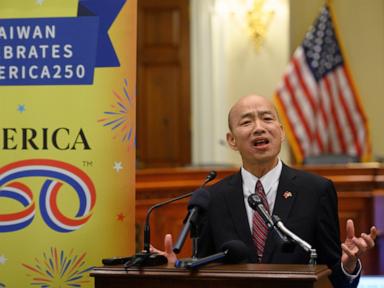
"On the international stage, Taiwan feels very lonely in its heart."
When Han Kuo-yu, the president of Taiwan’s Legislative Yuan, dropped that heavy line in the middle of a crowded Capitol Hill reception on Wednesday, he wasn't just making small talk. He was exposing the quiet desperation beneath the smiles and handshakes of high-level diplomacy. Discover more on a similar topic: this related article.
The image of over 30 U.S. lawmakers streaming into the Longworth House Office Building to welcome Han looks great on paper. You have Speaker Emerita Nancy Pelosi talking about maritime commerce, and Texas Republican Michael McCaul flat-out declaring his love for the island. It feels like a rock-solid wall of American backing.
But look past the cameras. This high-profile visit lands at a incredibly fragile moment. Right now, a massive $14 billion arms sales package for Taiwan is stuck in a bureaucratic holding pattern, sitting on the desk of a Trump administration that is openly reviewing the deal months after Congress gave it the green light. Additional journalism by NBC News explores related perspectives on the subject.
That delay is the real story. While politicians offer nice words, Taiwan is watching the calendar, wondering if Washington’s actual defense commitments are shifting.
The Semiconductors in the Desert
Han's path to Washington didn't start in a smoke-filled room in D.C. It started in the scorching heat of Phoenix, Arizona.
Before landing at Dulles, Han and his eight-person parliamentary delegation toured the massive, expanding factories of Taiwan Semiconductor Manufacturing Co. (TSMC). It’s a smart political play. By reminding American officials exactly where the advanced microchips powering the global artificial intelligence boom come from, the delegation made their security argument practical instead of abstract.
Taiwan isn't just an island of 23 million people fighting for democratic ideals. It's the literal backbone of the modern tech economy. If those Phoenix factories tell us anything, it’s that America wants to secure that supply chain on home soil. Yet, domestic manufacturing takes years to scale up. For now, the world remains entirely dependent on the physical peace of the Taiwan Strait.
That dependency is reflected in trade data. Taiwan recently surpassed Germany to become the fourth-largest trading partner of the United States. Think about that for a second. A self-governed island smaller than the state of Maryland is out-trading Europe's biggest economic engine, almost entirely because of tech hardware.
The Stuck Fourteen Billion Dollars
When Pelosi emphasized that American support for Taiwan is "bipartisan and bicameral," she wasn't exaggerating the mood in the room. House Democrats even issued a blunt statement urging the administration to execute the $14 billion weapon transfer immediately to counter growing coercion from Beijing.
But why the hold-up?
President Donald Trump indicated after his May trip to Beijing that he would review the package. Beijing naturally despises the arms deal, viewing it as an infringement on its territorial claims. Under the Taiwan Relations Act, Washington is legally required to provide Taipei with the hardware necessary to defend itself.
The friction here isn't between Democrats and Republicans. It's between a Congress eager to show strength and an administration keeping its cards close to its chest, potentially viewing the arms package as a chip in broader geopolitical negotiations.
Texas Democrat Lloyd Doggett hit that head-on during the reception, stating bluntly that Taiwan is not a bargaining chip. But when a multi-billion-dollar defense package stalls during a presidential review, it’s easy to see why officials in Taipei get nervous.
Understanding the KMT Tightrope
To understand why this visit is complex, you have to look at Han Kuo-yu himself. Han is a heavy hitter in the Kuomintang (KMT), Taiwan's main opposition party.
The KMT walks a brutal political tightrope. Historically, they favor more open dialogue and economic engagement with Beijing compared to President Lai Ching-te's ruling Democratic Progressive Party (DPP). Because of this, critics often worry the KMT might soften Taiwan's defense posture.
Han used his time on Capitol Hill to push back hard against that narrative. He praised America's democratic legacy and explicitly tied Taiwan’s identity to Western values of liberty and self-governance. By doing this, Han signaled to Washington that regardless of which party holds power in Taipei, the core alliance with the United States remains non-negotiable.
The Isolation Reality Check
While American lawmakers call Taiwan an island of freedom, Han's reminder about loneliness points to a brutal diplomatic reality.
Right now, only 12 governments on earth officially recognize Taiwan’s statehood. Beijing’s aggressive "One China" policy means countries must choose between diplomatic ties with the manufacturing powerhouse of the mainland or Taipei. Beijing has successfully locked Taiwan out of global bodies like the World Health Organization, leaving the island isolated during global crises.
This makes congressional visits lifeline events for Taipei. When the inaugural nonstop EVA Air flight takes off from Washington Dulles on Friday with Han's delegation on board, it will be celebrated as a symbol of shrinking distance between the two allies.
But flights and photo ops don't stop naval blockades. Hardware does.
What Happens Next
If you want to understand where U.S.-Taiwan relations are actually heading, stop watching the speeches and start tracking these three specific friction points over the coming weeks.
- The Arms Status: Watch the Federal Register and State Department briefings for any movement on that $14 billion package. If the review stretches past summer, it signals deep policy disagreements between the White House and Capitol Hill.
- TSMC Phoenix Progress: Monitor the production timelines of the Arizona fabrication plants. The faster those facilities become fully operational, the more it changes the strategic calculus for U.S. supply chain independence.
- Bilateral Trade Agreements: Look for updates on the U.S.-Taiwan 21st-Century Trade Initiative. Deepening formal trade structures is the fastest way Washington can counter Beijing's economic pressure on the island without triggering a direct military standoff.