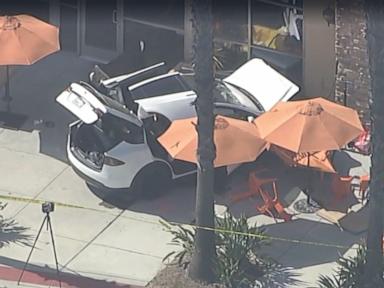
A white Tesla plowed directly into the outdoor patio of an Urbane Cafe in Simi Valley on Monday afternoon. The crash left one person dead and five others injured. It happened around 2:30 p.m. at the busy Target shopping center off Tierra Rejada Road and Madera Road. Emergency crews rushed to the scene. Aerial footage showed a chaotic mess of crushed outdoor tables, mangled umbrellas, and a vehicle with severe front-end damage.
It is a tragedy. But it is also part of a much bigger, quieter crisis that goes far beyond a single brand of electric car. You might also find this related article interesting: What Most People Get Wrong About Ayatollah Ali Khamenei's Funeral.
Whenever a Tesla is involved in a collision, the internet explodes. People instantly blame autopilot, full self-driving tech, or some sort of digital glitch. We saw it recently in Katy, Texas, where a Model 3 hit a home and killed a woman, sparking a massive lawsuit. Yet, safety data usually points to something far more human and far more common.
This latest disaster forces us to look at two uncomfortable truths. First, our modern parking lots are poorly designed to protect pedestrians from heavy vehicles. Second, pedal misapplication is an ongoing safety issue that drivers and automakers are not talking about enough. As discussed in recent coverage by BBC News, the effects are worth noting.
The Details of the Simi Valley Collision
The Ventura County Fire Department and Simi Valley Police Department responded quickly to the Target parking lot on June 29, 2026. Six victims were identified at the scene. One person died right there on the patio. Four others suffered minor to moderate injuries, while one suffered minor trauma.
The driver slammed right through the outdoor dining zone. Airbags deployed. Debris scattered everywhere. Investigators are currently looking into the black box data to see exactly what happened in those final seconds.
Was a driver-assist system turned on? We do not know yet. Police have not shared if the driver misjudged the pedal or if a medical emergency took place. What we do know is that a peaceful afternoon lunch turned fatal in the blink of an eye.
The Media Obsession with the Tesla Brand
Every single day, hundreds of traditional gas-powered cars crash into storefronts, homes, and restaurants across the United States. You rarely read about them. They are treated as local traffic statistics. But replace that generic sedan with an electric vehicle from Elon Musk's company, and it becomes international breaking news.
This intense scrutiny creates a skewed perception of safety. Critics use these moments to argue that high-tech vehicles are inherently dangerous robots operating out of control. On the flip side, brand defenders claim the media has a built-in vendetta.
The reality lies in the data. The National Highway Traffic Safety Administration (NHTSA) has spent years tracking automated driving systems. While software bugs do happen, the vast majority of storefront and parking lot crashes across all brands come down to human error. Specifically, people panic. They stomp on the gas instead of the brake.
High-horsepower electric cars react instantly when you floor them. There is no engine revving up to give you a split-second warning. The torque is immediate. If you press the wrong pedal in a vehicle that goes from zero to sixty in under four seconds, you are going to cover a lot of ground before your brain registers the mistake.
The Reality of Pedal Misapplication
Psychological and biomechanical studies show that pedal error happens way more often than drivers care to admit. The NHTSA estimates that pedal misapplication occurs about 16,000 times a year in the United States alone. That breaks down to nearly 44 instances every single day.
It usually happens in very specific environments. Parking lots. Drive-thrus. Car washes.
The driver is typically traveling at a very low speed. They are trying to park, pull up to a curb, or navigate a tight turn. Their attention is divided. Maybe they are looking for a parking spot, checking their mirrors, or glancing at a phone. Suddenly, the car moves in a way they did not expect. They panic. Their foot seeks the brake but lands squarely on the accelerator. Because the car surges forward, the driver presses down harder, thinking they are trying to stop the runaway vehicle.
This is not a software glitch. It is a biological panic loop. It affects drivers of all ages, though data shows it skews slightly higher for teenagers and elderly drivers.
Commercial Spaces Loll Drivers Into a False Sense of Security
Walk around any modern suburban strip mall. You will see outdoor dining tables placed just inches away from active parking spaces. Often, the only barrier separating a family eating lunch from a two-ton SUV is a thin concrete curb or a plastic planter.
Curbs do not stop cars. They are designed to redirect tires at incredibly low speeds, not block a vehicle under full acceleration.
The Urbane Cafe layout in Simi Valley is typical of these suburban designs. It sits in a high-traffic shopping center shared with a major Target store. Drivers are constantly pulling in, backing out, and circling for spots right next to where people are sitting outside.
Since the pandemic, cities and businesses have scrambled to expand outdoor seating. It is great for business. It is nice for the community. But from a structural safety standpoint, it creates a massive hazard if the space is not fortified with physical protection.
Moving Away from Symmetrical Architecture to Real Safety
To fix this, property owners and city planners need to stop prioritizing aesthetic symmetry over physical security. Look at the perimeter of most retail developments. They use light decorative railings or pretty shrubbery. These choices offer zero crash protection.
True safety requires heavy bollards.
A steel-core, concrete-filled bollard planted deep into the ground can stop a vehicle dead in its tracks. They do not have to look ugly. You can disguise them as heavy stone planters, thick concrete benches, or architectural pillars.
If you own a business with outdoor seating, relying on the city code to keep your customers safe is a mistake. Most local zoning laws are outdated. They do not account for the massive weight and quick acceleration of modern electric vehicles and heavy SUVs.
What You Can Do Immediately to Stay Safe
You cannot control how other people drive. You cannot predict if a vehicle next to you will suffer a sudden mechanical failure or a driver panic attack. However, you can change how you navigate these commercial spaces.
Pick Your Seat Wisely
When dining outside at a cafe or restaurant, avoid sitting at the tables closest to the parking spaces or the main driveway. Sit deeper into the patio space. Put structural elements like heavy walls, pillars, or large brick planters between yourself and the traffic flow.
Stay Alert in Parking Lots
Treat parking lots like active roadways. Keep your eyes up. Avoid looking down at your phone while walking from your car to the store entrance. Watch the brake lights of parked cars to see if someone is about to back out or pull forward unexpectedly.
Business Owners Must Audit Their Frontage
If you manage a retail store or restaurant, walk outside and look at your building from a driver's perspective. If a car accidentally accelerated instead of braking while parking in front of your window, what would stop it? If the answer is just glass and drywall, you need to invest in security bollards or heavy perimeter barriers immediately.
The investigation in Simi Valley will eventually reveal the official cause of this tragedy. Whether it was a medical crisis, a distracted driver, or a technical failure, the outcome remains a stark warning. Our shared public spaces require better physical boundaries to protect human lives from the heavy machinery we operate every day.