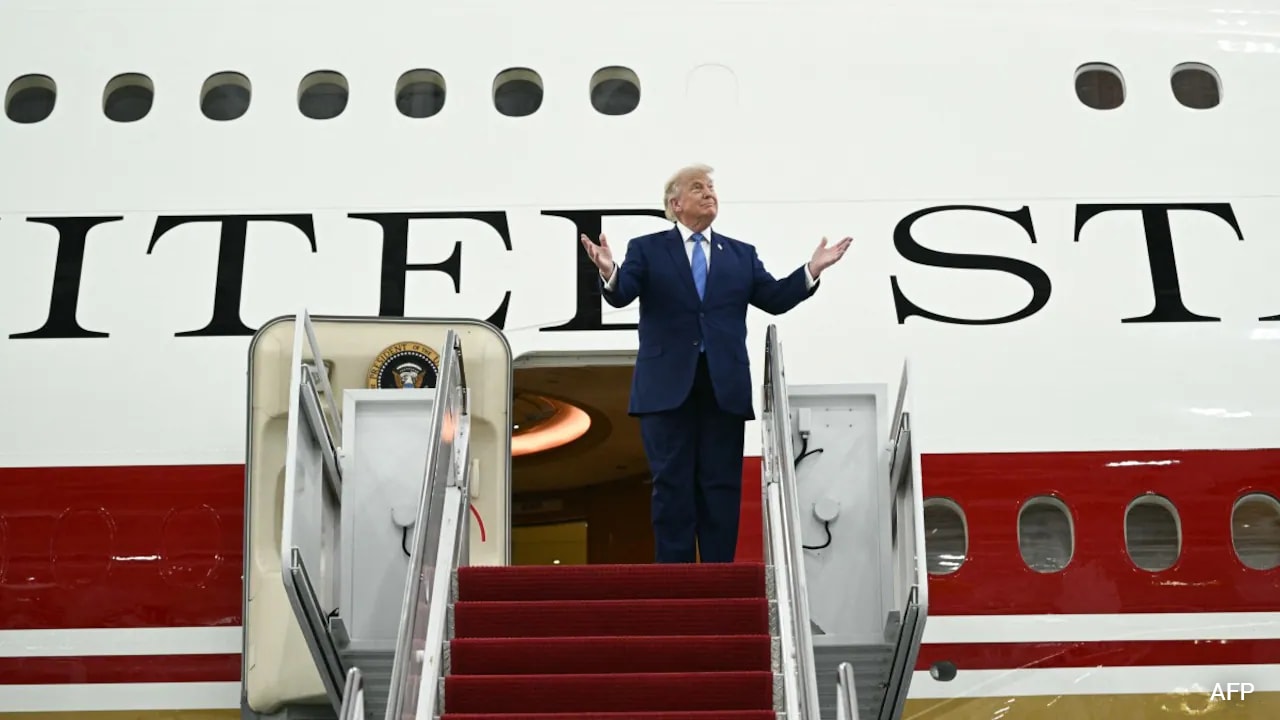
Donald Trump is getting ready to fly to North Dakota this Wednesday on a massively upgraded Boeing 747-8, a plane that didn't cost American taxpayers a single dime to buy. Instead, this flying mansion was a direct present from Sheikh Tamim bin Hamad Al Thani, the Emir of Qatar. While the White House frames this trip as a celebration ahead of America’s 250th birthday, the flight highlights a messy reality involving corporate delays, global power plays, and deep ethical questions.
You might wonder why the president of the United States is flying around in a secondhand foreign royal jet. The short answer is that Boeing messed up. The official program to replace the aging presidential fleet is years behind schedule and billions over budget. Trump got tired of waiting. When Qatar offered up a $400 million luxury jumbo jet, he took it. This Wednesday flight marks the formal operational debut of what the military officially calls the VC-25B Bridge aircraft, but everyone else knows it as the ultimate status symbol of modern diplomacy. You might also find this connected coverage interesting: Why The Venezuela Earthquake Tragedy Is Worse Than The Official Numbers Show.
The Story Behind The Controversial Presidential Plane
The aircraft flying Trump to his next campaign-style stop has a wild history. It started its life as part of the Qatar Amiri Flight, the exclusive fleet used only by the Qatari royal family. Built in 2012, the plane was packed with master bedrooms, gold-plated fixtures, and massive dining rooms. It looked less like a military transport and more like a high-end penthouse that somehow found its way into the clouds.
When Boeing continued to push back the delivery of the actual new Air Force One planes to 2028, a gap emerged. Trump openly complained about the state of the current presidential aircraft, which are essentially modified 1980s-era Boeing 747-200s. They are old, expensive to maintain, and lack the advanced communications required for modern executive duties. As reported in detailed coverage by The Washington Post, the implications are notable.
Qatar stepped in with an offer that Trump later said he would be stupid to refuse. The plane was officially transferred to the United States government as a gift. The administration argues that because it belongs to the Department of Defense and will eventually head straight to Trump’s future presidential library, it does not violate laws regarding foreign gifts to individuals. But that legal loophole hasn't stopped critics from screaming foul.
Inside The Massive Remake Of A Royal Jumbo Jet
The Air Force did not just take the keys from the Qatari royals and clear Trump for takeoff. Military teams spent ten months stripping parts of the interior and packing the fuselage with highly classified gear. A standard royal transport doesn't have secure satellite communication lines that can withstand an electromagnetic pulse from a nuclear blast. It doesn't have anti-missile defense systems or specialized medical theatres.
The defense department notes that they tried to keep the existing layout largely intact to save time. They focused on mission capability over purely aesthetic overhauls. Even with those cut corners, Trump couldn't resist putting his personal stamp on the exterior. The historic light blue and white paint job designed during the Kennedy administration is gone. Instead, the plane features a bold navy blue, bright white, and deep red scheme designed to match Trump's personal taste.
The result is a hybrid machine. Half of it is an advanced airborne command post capable of running a nuclear war, and the other half is a palace featuring some of the most luxurious materials ever put into an airframe. Trump boasted at Andrews Air Force Base that nobody has ever seen an airplane built to this standard. He isn't completely wrong, though the path to getting it into the air was anything but standard.
Why Boeing Failures Forced America To Accept Foreign Handouts
The real embarrassment behind this flight is what it says about American industrial capacity. Boeing has been dealing with manufacturing crises, labor strikes, and safety scandals for years. The official program to build two brand-new presidential aircraft has been an absolute disaster for the company's bottom line. Fixed-price contracts signed years ago meant Boeing had to swallow billions of dollars in cost overruns out of its own pocket.
Because of those struggles, the scheduled 2024 delivery date vanished. Then the 2026 window missed the runway too. Now, officials expect those planes in 2028 at the earliest. The Air Force was stuck between a rock and a hard place. They could keep burning millions maintaining forty-year-old planes that belong in a museum, or they could accept a pristine, low-hour Boeing 747-8 from a Middle Eastern ally.
Choosing the Qatari jet solved an immediate logistical headache, but it set a bizarre precedent. The United States is the wealthiest superpower on earth, yet its commander-in-chief is flying to a domestic independence celebration on a plane donated by a foreign absolute monarchy because a domestic defense contractor couldn't deliver on time.
The Strategic Price Of A Free Four Hundred Million Dollar Jet
Nothing in global politics is actually free. Qatar did not hand over a premier piece of aviation hardware out of the goodness of its heart. The small, gas-rich peninsula sits in a highly volatile region, surrounded by much larger neighbors like Saudi Arabia and Iran. For decades, Qatar’s survival strategy has relied on making itself indispensable to Western powers, particularly the United States.
By providing a solution to an embarrassing American military deficit, Qatar bought immense goodwill. Trump has openly praised the Emir, calling him a fantastic guy and reminding audiences that the United States provides critical security guarantees to Gulf nations. This plane deal locks that relationship in even tighter.
Lawmakers on Capitol Hill have raised red flags about the optics. They worry about what kind of leverage this gives Qatar during sensitive diplomatic negotiations. When the United States needs to mediate issues in the Middle East, it becomes much harder to play an objective broker when the president is using a flying gift from one of the primary regional actors.
What Happens Right After The North Dakota Flight
Once Trump lands on Wednesday, the evaluation of this stopgap plane intensifies. The Air Force views these early trips as extended operational tests. Crews need to see how the modified electronic systems interact during real-world missions. They have to ensure that secret service communications remain completely unbroken while traveling at high speeds across domestic airspace.
The schedule for the plane is packed. After this initial domestic leg, the jet will be prepared for a massive ceremonial flyover over Washington DC on the Fourth of July to celebrate the nation's milestone birthday. Following that public display, the plane heads overseas. Trump intends to use it for the upcoming NATO summit in Turkey, a move that will put the Qatar-gifted aircraft directly on the world stage in front of America's closest military allies.
This jet is not a permanent fixture. It is a bridge designed to last just a few years until the official defense contract concludes. But during its short tenure, it will remain one of the most visible and heavily debated pieces of equipment in the entire United States military arsenal.
Actionable Steps To Track This Presidential Flight Security
If you want to understand how this unusual aviation arrangement affects public policy and defense spending, you don't have to just sit back and read opinion pieces. You can watch the situation unfold through several public channels.
First, keep tabs on the official flight tracking databases that monitor executive military movements. While presidential flights often mask their exact coordinates for safety, the arrival and departure times at public airports like Joint Base Andrews and regional stops in North Dakota are public knowledge.
Second, monitor the upcoming congressional defense budget hearings. Lawmakers are already planning to question Pentagon officials about the exact breakdown of the conversion costs. Tracking how much money went into modifying a free plane will tell you whether this deal actually saved taxpayers money or just shifted the financial burden around.