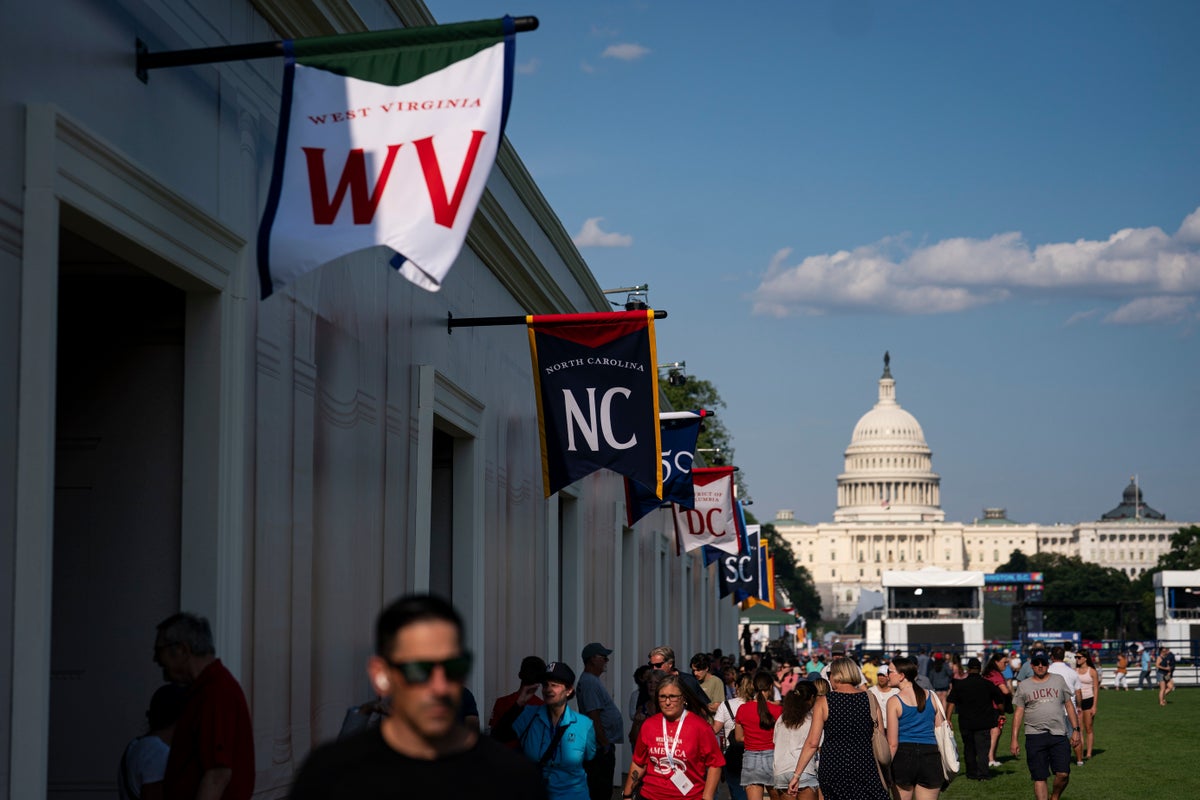
The National Mall was supposed to look like a Norman Rockwell painting this week. Instead, it looks like a logistical trainwreck. Donald Trump’s highly anticipated Freedom 250 Great American State Fair kicked off its 16-day run in Washington, D.C., but any hopes of a unified, nostalgic celebration of America’s 250th birthday vanished within the first 24 hours. Empty chairs, power outages, and melted ice cream defined the opening hours. Then came the real disaster: a digital monitor projecting a modified Confederate flag inside the North Carolina pavilion.
The backlash was instant, predictable, and entirely avoidable. It forces us to look past the surface-level political drama to see how poor event execution, political polarization, and private vendor chaos can ruin a major public event before it even gets off the ground.
The Friction in the North Carolina Pavilion
Here is what actually happened on the ground. The Great American State Fair relies heavily on individual state representation. Ten states flatly refused to officially participate. Some cited massive costs, while others pulled out due to concerns that the event was overly partisan. North Carolina’s state government was one of those official holdouts.
Because the state government refused to send an official delegation, organizers allowed a coalition of private North Carolina businesses to step in, fund the space, and manage the booth. On Friday, June 26, eagle-eyed visitors noticed a video loop running on multiple indoor screens. The video showcased a digital graphic blending elements of the current North Carolina flag with the distinct markings of the Confederate "Southern Cross" battle flag.
A visitor snapped a picture, uploaded it to social media, and the internet did the rest.
[North Carolina Official Flag] ── VS ── [The Fair's Altered Video Graphic]
(Red/blue bars, single star)            (Superimposed Confederate Battle Cross)
The blowback hit the corporate sponsors immediately. Mount Olive Pickle Company, an iconic North Carolina brand, pulled its funding and completely dropped out of the fair within hours of the image circulating.
Behind the Demands for Immediate Removal
North Carolina’s Democratic Governor, Josh Stein, did not wait around. His office fired off a blistering public statement demanding that Freedom 250 organizers scrub the display immediately.
"This flag does not represent the North Carolina that we love," Stein's office stated, emphasizing that the display completely weaponized a symbol of division at an event explicitly billed as a celebration of national unity.
The state government had to clarify that they had zero role in designing, vetting, or approving the pavilion's content. A spokesperson for the private companies running the pavilion claimed the image was "unapproved" and blamed it on a rogue video loop. They cut the feed as soon as the governor's office intervened, but the damage was done. The incident highlighted a glaring vulnerability: when public institutions back out of highly politicized events, private entities fill the vacuum, often without strict oversight or content vetting.
Why the Fair is Sputtering on the National Mall
The flag controversy isn't happening in a vacuum. It is the tipping point for an event that is fundamentally struggling to find its footing.
I checked the early crowd reports, and the optics are rough. Live television footage and social media dispatches from opening day revealed vast blocks of empty seats right before Trump took the stage. While Trump claimed on Truth Social that 45,000 people attended, journalists and attendees on the ground documented sparse sections and early departures during the headline speech.
The operational failures make the situation worse. Opening day saw localized power outages on the National Mall. Food vendors struggled to keep equipment online, leading to long lines for lukewarm food and melted ice cream. Typical state fair staples—the expected cornucopia of deep-fried comfort food—were largely missing or understaffed. To top it off, severe summer storms forced organizers to temporarily shut down the entire layout over the weekend, sending wet fairgoers scrambling for shelter.
What Event Organizers Can Learn From the Fallout
If you are managing high-stakes corporate events, political gatherings, or public exhibitions, this mess offers a harsh lesson in brand management. Relying on decentralized, unvetted vendors under a highly polarized brand name is a recipe for operational failure.
- Establish Centralized Content Auditing: If your event carries a prominent brand or political name, you cannot afford to give third-party vendors blind trust. Every video loop, graphic, and promotional banner needs sign-off from a central compliance team before doors open.
- Secure Tier-One Corporate Commitments Early: The moment an anchor sponsor like Mount Olive pulls out, the financial stability and public credibility of your event crater. Protect your revenue by implementing strict values-alignment clauses in vendor contracts.
- Build Redundant Power Infrastructure: If your venue is a public space like the National Mall, do not rely solely on existing municipal grids or basic generators. When power failures hit your food vendors, your visitor experience dies instantly.
The Great American State Fair runs through July, but turning the public narrative around will require more than just clearing up the weather. Organizers face an uphill battle to prove the event is a genuine national celebration rather than a chaotic, partisan sideshow.