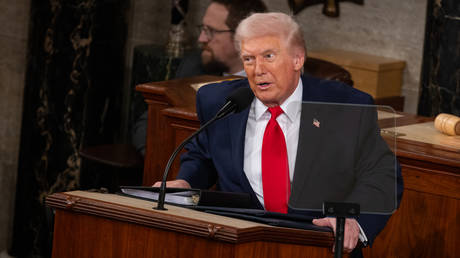
The fragile truce in the Middle East has completely broken down, and the global shipping sector is staring down a bizarre new reality. Following a chaotic weekend of missile exchanges, President Donald Trump announced that the United States is officially reinstating its naval blockade against Iran.
But he didn't stop there.
In a move that has stunned international maritime lawyers and delighted his base, Trump declared the U.S. is now "THE GUARDIAN OF THE HORMUZ STRAIT" and will demand a mandatory 20% toll on all eligible commercial cargo passing through the waterway to cover operational costs.
If you are trying to understand why oil prices just shot up 5% or whether global trade is about to break, you need to understand the structural shifts driving this crisis. This isn't just another standard diplomatic spat. It's a fundamental rewriting of how international waters are governed, backed by active U.S. military strikes.
The Breakdown of the Interim Peace Deal
To make sense of why things imploded so fast, we have to look at what happened over the last few weeks.
In June, the U.S. and Iran signed a temporary memorandum of understanding to halt the war that began back in late February. That initial war saw massive U.S.-Israeli airstrikes target Iranian military sites and result in the assassination of Supreme Leader Ali Khamenei. For a brief moment, the 60-day negotiation window looked like it might actually lead to a permanent ceasefire.
It didn't.
The underlying issue is control over the Strait of Hormuz—a narrow choke point that handled roughly 20% of the world's oil and gas before the war. Iran's new "Strait Authority" tried to assert administrative control over the channel, claiming it had the right to manage traffic and collect fees under their interpretation of the interim pact.
The friction turned violent when Iranian forces attacked a commercial container ship in the strait. Iran then declared the waterway closed, prompting Trump to declare the ceasefire dead.
Over the last 48 hours, the conflict went into overdrive:
- U.S. Strikes: Central Command (CENTCOM) launched heavy airstrikes hitting dozens of Iranian targets, including air defenses, coastal radars, drone facilities, and a submarine maintenance base.
- Regional Retaliation: Iran fired back with missiles and drones targeting U.S. allied facilities across the region. Sirens sounded in Bahrain—home to the U.S. Navy's 5th Fleet—while Kuwait and Jordan intercepted hostile incoming fire.
- The New Threat: Trump explicitly warned that the military is prepared to "take out" Pickaxe Mountain, a heavily fortified underground facility believed to hold Iran's uranium stockpile.
Re-Blockading Iran: How it Works This Time
This is the second time the U.S. has instituted a blockade here. The first iteration ran from April until it was temporarily lifted in June as part of the failed peace talks.
According to details released by the U.S. Navy-led Joint Maritime Information Center, the renewed blockade officially takes effect Tuesday at 4 p.m. ET (2000 GMT). It covers the entire Iranian coastline, including all major commercial ports and oil terminals.
[Persian Gulf] ----> [ Strait of Hormuz ] ----> [Gulf of Oman]
                          ^
              [U.S. Navy Blockade Line]
Don't confuse this with a total shutdown of the strait. CENTCOM clarified that the blockade is explicitly asymmetric. It aims to choke off Iran's economic lifeblood while keeping the channel functional for the rest of the world.
If a ship is flying an Iranian flag, or carrying cargo destined for or originating from an Iranian port, U.S. warships will intercept, divert, or capture it. If a neutral vessel is just transiting through the strait to deliver goods to non-Iranian destinations like Kuwait, Saudi Arabia, or the UAE, the U.S. says it will allow them safe passage. Humanitarian shipments are also technically permitted, though they must stop for U.S. military inspections first.
The 20% Toll Dilemma
The real curveball in Trump’s announcement is the financial demand. The U.S. is imposing a 20% tariff or fee on eligible commercial cargo moving through the strait.
The logic from the White House is pure business: if the U.S. Navy is spending billions of dollars risking American lives to keep international shipping lanes safe from Iranian missiles, the commercial shipping industry needs to foot the bill.
Naturally, this has triggered an immediate international legal panic. The United Nations' shipping agency pushed back hard, stating bluntly that there is zero legal basis under international maritime law—specifically the UN Convention on the Law of the Sea (UNCLOS)—to charge mandatory transit fees in international straits. Under long-standing maritime laws, "transit passage" through straits used for international navigation cannot be suspended, taxed, or impeded by coastal or patrolling states.
Interestingly, Iran’s Foreign Minister Abbas Araghchi took to social media to mock the scale of the fee rather than just the concept, posting that "20% is of course too much" before asserting that Iran remains the true, historic guardian of the waterway.
What This Means for Global Shipping and Supply Chains
If you are managing supply chains or trading commodities, the immediate outlook is highly volatile. While the U.S. claims it escorted around 20 vessels through the strait recently, real-time ship-tracking data tells a completely different story.
Vessel activity through the Strait of Hormuz plummeted by roughly 52% over the weekend compared to normal weekly averages. Major commercial shipping lines aren't waiting around to see how the U.S. enforces its 20% toll or how Iran aims its anti-ship missiles. They are dropping anchor or diverting entirely.
The economic fallout is materializing fast. Benchmark crude oil prices immediately jumped 5%, climbing back toward the $80-a-barrel mark. If the blockade drags on and the shipping drop-off holds, expect a cascading surge in global insurance premiums for maritime transport, which will inevitably translate to higher consumer prices for energy and manufactured goods globally.
Actionable Next Steps for Businesses and Observers
The geopolitical reality has fundamentally changed. You cannot rely on the old rules of maritime security. To protect your operations, implement these immediate steps:
- Audit Supply Chain Exposure: Identify any tier-1 or tier-2 suppliers relying on maritime transit through the Persian Gulf. Assume a minimum 50% delay in transit times through the Strait of Hormuz for the next 30 days.
- Review Freight Insurance Contracts: Contact your marine cargo insurers immediately. Confirm whether your current policies cover war risks, arbitrary state-imposed transit fees, or cargo diversions in the Middle East. Expect underwriters to implement strict "re-routing" clauses or spike premiums.
- Model a $90+ Oil Scenario: Factor a sustained energy price hike into your Q3 and Q4 operational budgets. The combination of reduced tanker traffic and active U.S. military strikes on Iranian infrastructure means energy market volatility will remain high.
- Track Alternative Routing Protocols: Monitor CENTCOM updates regarding the designated southern shipping route that hugs the coast of Oman. Ensure your logistics partners are briefed on U.S. Navy escort availability and inspection protocols to minimize transit bottlenecks.