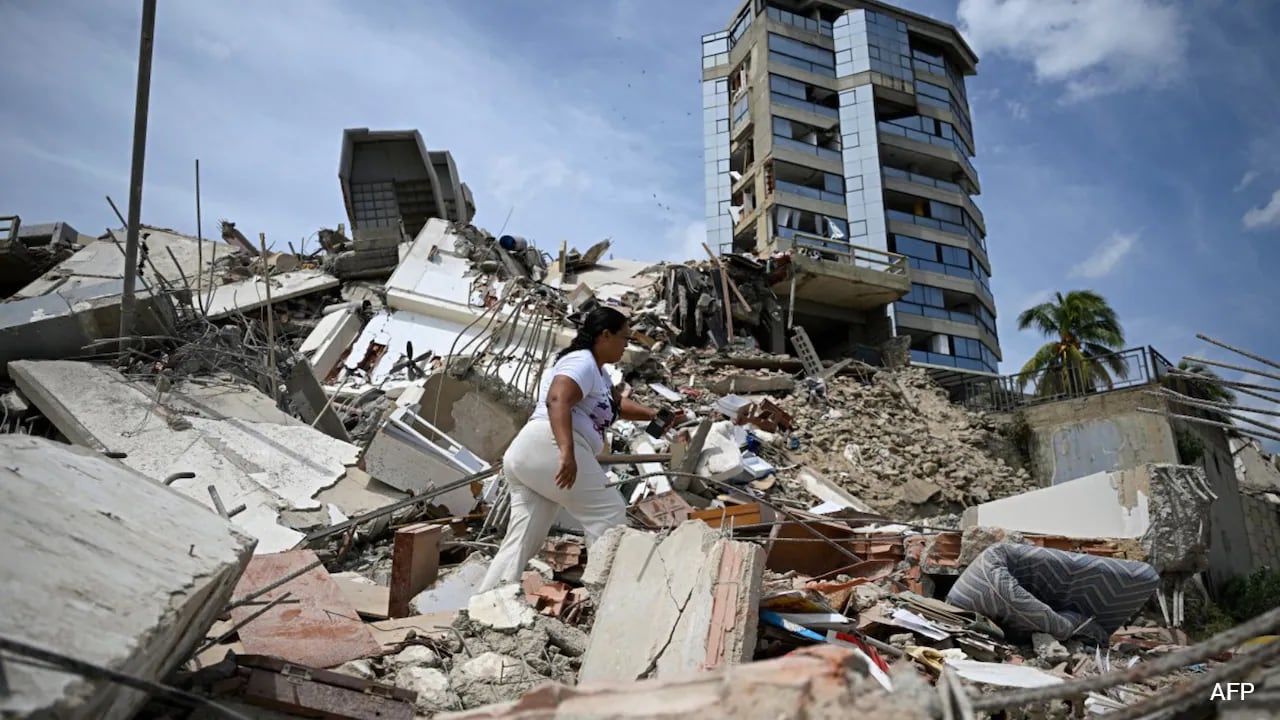
The ground shook twice, just minutes apart, and left a trail of crushed concrete and shattered lives. When twin earthquakes measuring 7.2 and 7.5 magnitude ripped through Venezuela, they didn't just topple buildings. They laid bare the sheer desperation of families left entirely to their own devices in the chaotic aftermath.
Take the case of Amparo del Giudice. She stands before a massive mound of shattered concrete that used to be a fifteen-story building, clawing at the debris until her fingers bleed. Her son is trapped underneath. Nearby, her twenty-three-year-old grandson, Alessandro, pulls on a volunteer firefighter helmet, sobbing as he looks at the ruins. Meanwhile, you can find similar stories here: Why Super Typhoon Bavi Is The Nightmare Scenario For The Us Pacific Islands.
"He is in there," he says.
It is a scene of raw agony. But it's also a damning indictment of a crisis response system that left citizens digging through tons of rock with nothing but their fingernails. The recent Venezuela earthquake disaster has claimed over 235 lives and injured thousands, yet the true tragedy lies in the gap between the scale of this disaster and the reality of the rescue efforts on the ground. To see the bigger picture, check out the detailed analysis by USA Today.
The Reality of Twin Earthquakes in a Vulnerable Infrastructure
When seismologists talk about a doublet earthquake, they mean two massive tectonic events happening almost simultaneously in the same area. That's exactly what smashed into Venezuela. The first shock cracked the foundations; the second, hitting just a minute later, brought the structures down.
Most people don't realize how vulnerable modern cities are to these back-to-back shocks. Engineers design buildings to survive a single big hit, expecting time for evacuations before any major aftershocks. When a second 7.5 magnitude quake hits sixty seconds later, the weakened concrete has zero structural integrity left. Buildings simply pancake.
The epicentre near Moron turned residential zones into instant graveyards. High-rises collapsed into compact layers of rubble, trapping anyone who couldn't sprint out within those first sixty seconds. For families like the del Giudices, the immediate window for survival shrank down to nothing.
Why Hand Digging Is a Desperate and Deadly Race Against Time
Watch any news clip of a major disaster and you'll see people scrambling over ruins, lifting rocks by hand. It feels heroic, and it is. But honestly, it's also incredibly ineffective against reinforced concrete.
Amparo del Giudice admitted the brutal truth while sitting near the pile where her son remains trapped. She pointed out that it's a lot of rock, and doing this with bare hands is impossible. She's right. A single cubic yard of concrete weighs about four thousand pounds. When a fifteen-story building collapses, you're dealing with millions of tons of heavy material packed tightly together.
Without heavy machinery, hydraulic jacks, and acoustic listening devices, manual rescue efforts rarely move fast enough to save people trapped deep in the void spaces. Air supplies run out. Internal injuries turn fatal. The lack of ready-to-deploy heavy equipment in the first forty-eight hours basically seals the fate of hundreds of trapped victims.
The Broken Infrastructure and the Delayed Response
In the hours following the tremors, the absence of organized government search and rescue teams in many hard-hit neighborhoods became painfully obvious. Desperate relatives waited for hours, then days, watching the dust settle while nobody came to help.
The political and economic reality in Venezuela has severely weakened its emergency response capabilities over the last decade. Fire departments lack functioning trucks. Civil defense units don't have the fuel or tools they need. When a disaster of this scale hits, the system doesn't just strain; it completely breaks down.
While acting President Delcy Rodriguez announced a two hundred million dollar reconstruction fund using resources from the International Monetary Fund, money on paper doesn't lift a concrete slab off a trapped survivor today. Emergency funds are great for rebuilding bridges and roads next month, but they don't solve the immediate crisis of a mother bleeding from her hands trying to save her child.
International Aid and the Logistics of Relief
Some relief has started to arrive. India dispatched medical aid and rescue supplies under an initiative called Operation Amistad. Neighboring countries are trying to send search teams. But getting that aid from an airport tarmac to a collapsed building in a ruined neighborhood is a logistical nightmare.
With local airports shut down or damaged, roads cracked open, and communications down, international teams face massive delays. Every hour spent negotiating customs, sorting through logistics, or finding fuel for transport vehicles is an hour lost for those under the rubble.
True disaster management requires pre-positioned supplies and immediate, frictionless entry for international rescue specialists. When bureaucratic hurdles or damaged infrastructure slow down these teams, the burden falls squarely back onto the shoulders of untrained, ill-equipped citizens.
Steps to Take If You Want to Help Venezuela Right Now
Don't just watch the news and feel bad. If you want to make a tangible difference for the families dealing with this disaster, you need to direct your resources where they actually matter.
First, support international disaster response organizations that already have a footprint inside the country. Groups like the International Federation of Red Cross and Red Crescent Societies or Doctors Without Borders often bypass the political bottlenecks that stall state-level funding. They turn donations into field hospitals and water purification units within days.
Second, advocate for international policies that prioritize humanitarian corridors during natural disasters. The people digging with their bare hands don't care about geopolitics. They need heavy lifting gear, trained rescue dogs, and medical personnel on the ground immediately.
The tragedy in Venezuela proves that when the earth fractures, the thin veneer of official preparedness vanishes fast. Families will always do whatever it takes to save their children, even if it means tearing their hands to pieces on broken concrete. The rest of the world needs to ensure they don't have to do it alone.