The golden window for earthquake survival is brutally short. Usually, after 72 hours under crushed concrete, hope evaporates. Dehydration, crush injuries, and suffocating dust finish what the tremors started.
But Hernán Alberto Gil Flores didn't get that memo.
On July 2, 2026, international rescue teams pulled the 43-year-old nightshift security guard out of the collapsed basement of the Galerías Playa Grande shopping center in La Guaira, Venezuela. He spent eight grueling days buried under 140 tonnes of fractured concrete and twisted metal.
His extraction wasn't just a lucky break. It was a masterclass in extreme urban search and rescue that pushed human endurance and engineering to the absolute limit.
The Microscopic Space That Kept Him Alive
When the twin earthquakes measuring 7.2 and 7.5 magnitude shattered the coastal town of Catia La Mar on June 24, entire neighborhoods folded. The seven-story commercial complex pancaked instantly into its own parking basement.
Gil Flores was inside his tiny security workstation cabin when the first violent tremor hit.
In a disaster, your immediate environment determines your fate. While the heavy concrete slabs overhead pulverized everything around him, his small metal reinforced cabin held its ground. It didn't buckle. Instead, it deflected the brunt of the falling debris, creating a structural void.
This void gave him a vital pocket of air.
Survival requires air, but it also requires a terrifying amount of mental control. Heavy dust from pulverized masonry can suffocate a person within minutes of a collapse. Gil Flores managed to survive the initial dust cloud inside his tiny booth, sitting in pitch darkness beneath millions of pounds of unstable wreckage, completely cut off from the outside world.
A Secret Kept From a Wife
A specialized team from the Costa Rican Red Cross first detected signs of life on Sunday, four days after the initial disaster. They used sensitive acoustic equipment and telescopic cameras threaded through tiny gaps in the rubble to locate him.
When they finally made voice contact, Gil Flores said something that stunned the rescue crew.
He asked them not to tell his wife he was alive. He was terrified that the rescue would fail, and he didn't want to give her false hope only to have it ripped away if the structure shifted and crushed him.
His wife, Gusbimar González, was already living through a nightmare. She spent days assuming her husband was dead, caring for their two children, aged 8 and 10. When the rescue teams eventually broke the news to her that they had located him, she described it as a ray of light in total darkness.
Finding a survivor is only the first step. Getting them out is a completely different logistical nightmare.
The Seventy Hour Tunnel Through Hell
The operation to extract Gil Flores took nearly three full days of continuous, exhausting labor. Urban search and rescue experts from Chile, the United States, Portugal, El Salvador, and Mexico joined Venezuelan emergency crews to coordinate the effort.
Manny Sampang, a task force leader from the Los Angeles County Fire Department, pointed out the extreme danger of the site. Multiple heavily damaged buildings were literally leaning into the ruins of the shopping center. Every aftershock threatened to bring the whole mass down on top of both the survivor and the rescuers.
Chilean firefighters took the lead on the technical extraction. They had to tunnel down 8.8 meters through shifting concrete slabs.
It was slow, terrifying work. The rescue teams had to build custom wooden and mechanical shores to hold up the ceiling of their makeshift tunnel as they dug. Several times, parts of the access ducts collapsed from the weight of the debris and the frequent aftershocks. Torrential tropical rain added to the misery, slicking the rubble and increasing the weight of the debris.
Rescuers managed to pass a small hose and a syringe through a tiny borehole into his cabin. For three days, they pumped water, liquid nutrients, and crucial medications directly to him. They also slipped a face mask and protective goggles through the gap. The rescue work created thick clouds of toxic concrete dust inside his small pocket, and he needed the gear to protect his lungs and eyes.
Defying the Medical Odds
During the final hours of the rescue on Thursday morning, a veteran Chilean firefighter named María Paz Campos stayed on the microphone, talking Gil Flores through the process to keep his heart rate down. Panic causes hyperventilation, which can quickly deplete the limited oxygen remaining in a structural void.
Remarkably, a video feed from the rescue camera showed Gil Flores drawing on a scrap piece of paper inside his booth to pass the hours.
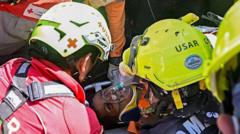
When emergency workers finally cleared the last barrier, they found him in shockingly good physical shape. Ricardo Arias of the Costa Rican Red Cross reported that Gil Flores didn't even have a crushed fingernail. He was uncomfortable from the cramped space and the pressure of the surrounding rocks, but he was entirely intact.
As rescuers carried him out on a stretcher wrapped in an orange tarp, hundreds of emergency workers from different nations broke out into cheers, embracing each other in the mud.
The Grim Reality Beyond the Miracle
While Gil Flores became an instant national icon of survival, his story is an exception in a landscape of immense tragedy. The twin quakes have claimed nearly 2,300 lives, left over 11,000 injured, and displaced tens of thousands of people across Venezuela.
In La Guaira, the vast majority of collapsed buildings have already been spray-painted with the letter "D" by international search teams. That letter stands for deceased. It means K9 units and thermal imaging devices have scanned the ruins, found no signs of life, and moved on. The focus is rapidly shifting from rescue to recovery and disease prevention.
The country was already reeling from decades of deep economic hardship and severe infrastructure neglect before the tremors struck. Hospitals are under extreme pressure, lacking basic surgical supplies, clean water, and antibiotics.
What to Do Right Now
The window for finding more survivors under the rubble has closed, but the fight to keep the living alive is just beginning. If you want to help the relief efforts in La Guaira and surrounding regions, focus on organizations with existing logistical networks on the ground.
- Support Medical Supply Lines: Organizations like the International Federation of Red Cross and Red Cross Societies (IFRC) are actively coordinating with local chapters in Venezuela to distribute clean water tablets and trauma kits.
- Fund Field Hospitals: Direct donations to Doctors Without Borders (MSF) help supply the overwhelmed medical facilities treating survivors of the collapse.
- Keep Pressure on Aid Corridors: Stay informed through verified international news outlets to ensure bureaucratic hurdles don't block foreign aid shipments entering the country during this fragile political transition.