Miracles don't happen often in disaster zones. When they do, they usually teach us more about systemic failures than good luck. The recent story of the Venezuelan man rescued from rubble eight days after a catastrophic double earthquake is exactly that kind of wake-up call. On July 2, 2026, rescue teams pulled 43-year-old night-shift security guard Hernán Alberto Gil Flores from the shattered basement of the Galerías Playa Grande shopping center in La Guaira. He didn't just survive on grit alone. He survived because a tiny security booth held up against 140 tons of falling concrete, and because an international coalition refused to give up on him.
People are searching for this story looking for a feel-good moment in a dark week. Let's be real about what this actually means. The standard survival window for earthquake victims is 48 to 72 hours. Gil Flores smashed past that timeline by lasting more than 190 hours underground. While his extraction is a triumph of human spirit and global cooperation, it also highlights the stark reality of how poorly prepared local infrastructure is for catastrophic events.
The real story behind the Venezuelan man rescued from rubble
The twin earthquakes hit northern Venezuela on June 24, registering massive magnitudes of 7.2 and 7.5. The damage was immediate. Entire apartment blocks collapsed, leaving more than 2,200 dead and 11,000 injured. Gil Flores was caught directly in the epicenter of the destruction inside the coastal town of Catia La Mar.
Surviving inside a concrete tomb
When the first violent tremor shook the shopping complex, Gil Flores was inside his small metal security cabin. That booth saved his life. As the seven-story structure pancaked around him, the reinforced frame of the cabin held its ground. It deflected the heaviest blocks of concrete, creating a tight but viable air pocket.
He spent days in total darkness. The psychological toll was immediate. When a specialized team from the Costa Rican Red Cross finally detected signs of life on Sunday and established voice contact, Gil Flores made a heartbreaking request. He asked rescuers not to tell his wife, Gusbimar González, that he was alive. He genuinely believed he wouldn't make it out, and he didn't want to give his family false hope. The couple has two kids, ages eight and ten.
The international race against the clock
What followed was a brutal 100-hour extraction process. An urban search and rescue team of Chilean firefighters took the lead, coordinating with specialists from six other countries: the United States, Portugal, Mexico, Costa Rica, El Salvador, and Venezuela.
Rescue Operation Stats:
- Total time trapped: 8 days (approx. 192 hours)
- Extraction duration: Over 100 hours
- International teams involved: 7 countries
- Nutrients supplied: 10+ liters of water via narrow shaft
Rescuers had to dig a three-meter tunnel through highly unstable debris. Torrential rain and constant aftershocks threatened to collapse the remaining ruins on top of both the victim and the rescue crews. They used a telescopic camera to keep tabs on him. To keep him alive past the typical biological threshold, crews passed water and liquid nutrients down a narrow shaft.
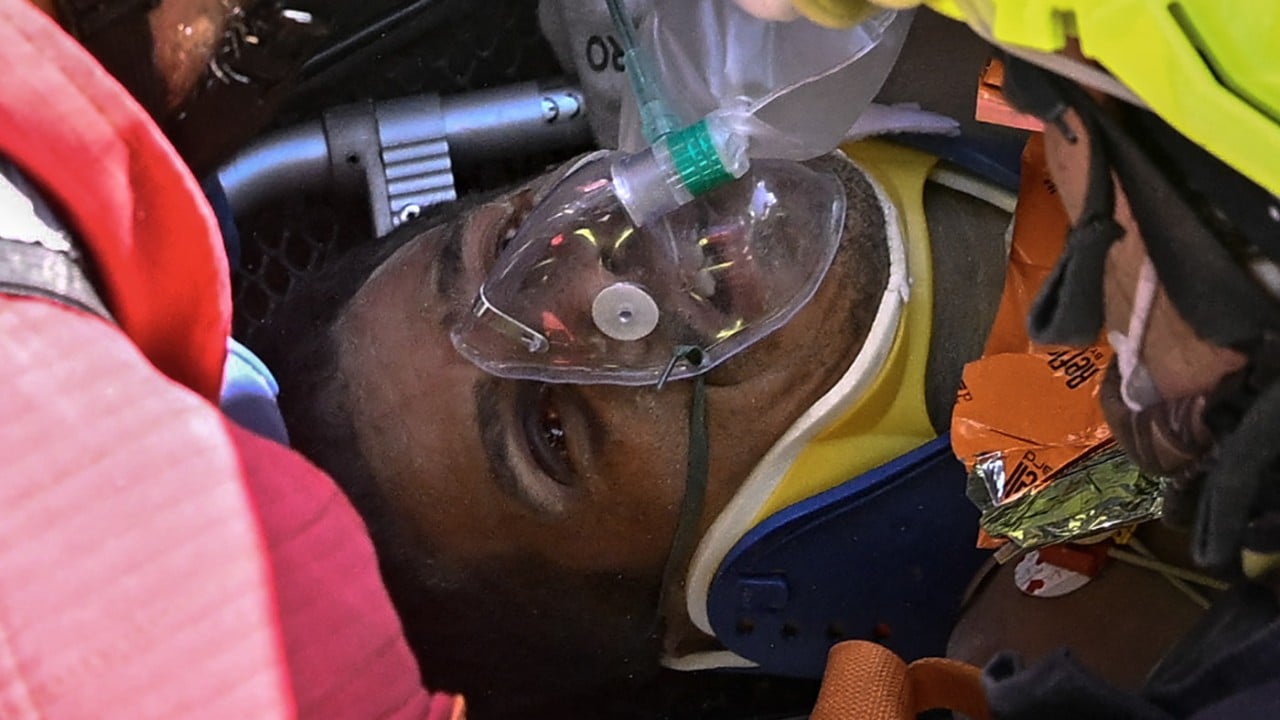
Throughout the final grueling hours, a veteran Chilean firefighter named María Paz Campos stayed on the radio with him. She kept him calm and focused. In videos captured right before the rescue, Gil Flores was actually drawing pictures on scraps of paper to keep his mind occupied. Campos gently ordered him to put on protective goggles to shield his eyes from falling concrete dust as they broke through the final barrier. Early Thursday morning, he finally emerged on a stretcher covered in an orange tarp, breathing through an oxygen mask to the cheers of hundreds of rescuers.
What this survival tells us about modern search and rescue
We need to look past the emotion and examine the technical reasons this operation succeeded. This wasn't just luck. It was highly coordinated execution that offers clear takeaways for future urban disasters.
First, the creation of survival voids is everything. When buildings collapse, structural elements like heavy furniture, reinforced cabins, or structural beams create small triangles of space. Gil Flores survived because he stayed inside a rigid structural unit. In a major quake, finding or staying near load-bearing, rigid objects saves lives.
Second, the old rules about the 72-hour survival window are outdated if teams can establish early contact. By successfully feeding more than ten liters of fluids through a tiny borehole, tech-savvy rescue teams bought themselves an extra four days to cut through the concrete. Heavy machinery would have triggered a secondary collapse. Slow, deliberate hand-tunneling was the only way, and the hydration line made that slow approach possible.
The grim reality behind the miracle
We can applaud the international teams, but we can't ignore the political fallout. Acting Venezuelan President Delcy Rodríguez took to social media to praise the "greatness of humanity" and the global unity on display. However, ordinary citizens aren't buying the government spin.
The rescue of one man is a brilliant achievement, but thousands of others didn't get that chance. Regular Venezuelans are furious over the government's slow, disorganized disaster response. Local hospitals are completely overwhelmed. Food and clean water are vanishingly scarce across La Guaira state. Emergency experts are already sounding the alarm about imminent waterborne disease outbreaks. The reality is that building codes in the region were completely ignored for years, turning modest earthquakes into mass-casualty events.
If you want to support real recovery efforts or prepare your own family for structural emergencies, stop treating these stories like simple entertainment. Take direct action. Support boots-on-the-ground international first responders like the Red Cross or independent urban search and rescue networks that actually have the gear to tunnel through concrete. Learn the structural weak points of your own home or workplace. Gil Flores survived because he had a rigid shield around him. Make sure you know where your own safe zones are before the ground starts moving.