History has a funny way of erasing the people who don't fit the approved script. In the mainstream tellings of Chinese immigrant history, you hear about railroad workers, family associations, and merchants building a sanctuary in the face of brutal American exclusion. You rarely hear about the gay men who found refuge in those same alleyways or the lesbians who had to hide their love inside the traditional culture.
That silence just cracked wide open.
At the end of May 2026, a tiny storefront in San Francisco Chinatown became something completely unprecedented: the OUT Museum, the world’s very first Chinese-language queer museum. It sits on a quiet hillside corner, right across from the Chinese Historical Society of America Museum. It is currently just a single room, only open on Saturdays, and holds fewer than a dozen pieces of art. Yet, its existence is a massive middle finger to decades of state censorship in China and institutional neglect in America.
If you think this is just another trendy pop-up gallery in a progressive city, you're missing the entire point.
The Long Journey to a Saturday Storefront
To understand why this single room matters, you have to look at the woman who built it. Xiangqi Chen spent more than twenty years pushing for LGBTQ+ visibility in China. She even founded the Shanghai Lesbian Center years ago. She watched firsthand as the Chinese government systematically shut down queer spaces, scrubbed digital archives, and made public organizing virtually impossible.
Six years ago, while trapped in her Shanghai apartment during a lockdown, Chen sketched out a wild idea. She wanted to create a museum to salvage China’s disappearing queer history before it was completely wiped clean. She launched a Kickstarter campaign, and more than 2,000 people donated from across the globe. But Chen isn't naive. She knew the Chinese authorities would never let her build it on Chinese soil.
So, she packed her life up. In 2022, she managed to get to the United States as a visiting scholar at Georgetown University. By 2024, her work caught the eye of arts leaders in San Francisco, leading to a residency with the Chinese Culture Center of San Francisco. That residency became the perfect incubator for what would eventually become the OUT Museum.
Think about the sheer irony of that trajectory. Chen had to flee her homeland just to build a monument to its people. She found her public platform in America's oldest Chinatown—a place that carries its own complicated baggage when it comes to accepting queer identities.
Why Chinatown is the Perfect Sponge
When Chen first arrived in San Francisco, she fell in love with Chinatown. It felt simultaneously alien and familiar. She noticed that the history of Chinese immigrants constantly fighting for a physical piece of ground echoed her own struggle for queer survival.
Chinatown is incredibly resilient. Chen describes the neighborhood as a sponge that can absorb differences, survive immense pressure, and somehow keep its core intact. For generations, it has been a sanctuary for people with nowhere else to go.
But it hasn't always been an easy sanctuary for LGBTQ+ individuals. The community has historically been deeply conservative, anchored by traditional family clans and merchant associations that prioritized assimilation and survival above all else. For decades, being openly queer meant risking total banishment from the only safety net you had in a racist America.
That is what makes the location of the OUT Museum so radical. It doesn't sit in the Castro, San Francisco's famous gay neighborhood. It sits right in the beating heart of Chinatown, demanding to be seen by the grandmas pulling market carts and the immigrant families walking down Clay Street. It forces a collision between two worlds that have spent a long time pretending the other didn't exist.
The Art of Unarchived Lives
The museum might be small, but the work inside is dense with subtext. The pieces don't just sit there to be admired; they pull back the curtain on stories that people were forced to hide for decades.
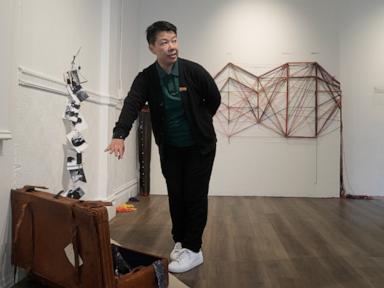
Take Chen’s own installation, titled The Weight of Kindness. The centerpiece is an old, weathered suitcase filled with photographs of Chinese queer people. Look closely at the images, and you notice something haunting: every single person is hiding their face.
The piece was directly inspired by a true story from the 1970s. A gay Chinese immigrant came to San Francisco and found a quiet, unspoken refuge within Chinatown, even though the neighborhood was notoriously conservative at the time. People knew, but they didn't say. The suitcase represents that exact tension—the heavy burden of having to conceal your true self just to receive the basic kindness of community acceptance.
Then there is the work of Dixon Ngai, an artist who moved to San Francisco from Hong Kong. Ngai actually came out after arriving in the city, finding a sense of personal liberation that was impossible back home. His contribution to the inaugural exhibit is a hand-painted, traditional Chinese porcelain wine pot.
It looks like a classic artifact, but it is deeply subversive. The design is inspired by Di Nü Hua (The Flower Princess), a famous Cantonese opera. Ngai uses traditional artistic mediums to weave his own queer narrative, reclaiming a cultural heritage that mainstream society often uses to exclude people like him. During the museum's grand opening, Ngai even performed a piece of Cantonese opera while dressed in traditional attire, bridging the gap between ancient high art and modern queer identity.
The space also features an interactive installation that breaks down the cold wall between the viewer and the art. Visitors walk up to a board filled with nails, each representing different gender identities and sexual orientations. You take a piece of colored thread and physically weave it from nail to nail, tracing your own messy, beautiful journey of self-discovery. By the end of the day, the board becomes a tangled, chaotic map of collective human experience, showing exactly how interconnected these seemingly isolated paths really are.
The Generation Gap and Unexpected Allies
The true measure of this museum isn't found in art reviews. It is found in the people walking through the door. Chen says she has been completely overwhelmed by the reactions from older Chinese immigrants, both straight and queer, who have lived in California for decades.
During the opening weeks, an elder transgender man in his 60s walked into the room. He shared his story with the volunteers, explaining how he had immigrated to San Francisco all the way back in the 1970s specifically to seek gender-affirming care that was non-existent elsewhere. For fifty years, his story was just a private memory. The museum gave him a place to finally put it down.
Another day, an older Chinese mother came in. Her adult son had recently come out to her. She didn't know who to talk to, and she didn't know how to navigate her own feelings within her cultural circle. She came to the museum simply looking for a way to understand him better, expressing immense gratitude that a bilingual space like this existed.
These interactions are crucial because they shatter the myth that queer identity is a modern, Western import. Traditional Asian cultures often frame homosexuality as a white, Western phenomenon or a disease of the young and decadent. Having a space where the text is explicitly bilingual, and the cultural touchstones are thoroughly Chinese, proves that queer people have always been here.
This sentiment is echoed by people like Crystal Jang, an 80-year-old activist who was born and raised right in San Francisco Chinatown. Jang and her wife, Sydney Yeong, grew up together in the neighborhood. Their fathers owned shops just around the corner from one another. Both women realized they were queer when they were just 13 years old.
Back then, you didn't dare say a word. You had to hide your identity deep inside the culture just to survive. In 1996, Jang and Yeong were part of the very first contingent of about 100 LGBTQ+ Asian Americans who dared to march in the Chinatown Lunar New Year Parade. Jang remembers that many people in their group wore masks because they were terrified that their families or employers would recognize them.
When Jang stands inside the OUT Museum today, she sees the ultimate validation of a lifetime of quiet resistance. The queer stories were always blowing through the alleys of Chinatown. They were just left out of the history books.
Facing the Modern Crosswinds
The opening of the OUT Museum comes at a bizarrely polarized moment in time. On one hand, San Francisco remains a progressive bubble where Mayor Daniel Lurie and various city officials proudly turned out to cut the rainbow ribbon alongside legendary activist Helen Zia.
On the other hand, the broader political climate is tightening. Across the United States, legislative bodies are aggressively moving to restrict LGBTQ+ rights, censor books, and roll back protections for transgender individuals. The safety that many queer immigrants came to America to find feels increasingly fragile.
Chen notes a massive difference between American-born Chinese queer people and those arriving fresh from mainland China. The American-born generation grows up with much more vocabulary around gender and identity, alongside structural support systems. Immigrants arriving from China are often fleeing a modern state apparatus that has made queer content illegal online and systematically erased civil society organizations.
For these new arrivals, the museum isn't just a place to look at art. It is a vital school for survival. It shows them that their identity doesn't require them to discard their heritage. You can be entirely Chinese and entirely queer at the exact same time.
How to Support the Movement Right Now
The OUT Museum is a beautiful prototype, but it is currently running on pure grit and volunteer labor. It doesn't have the deep pockets of major city institutions. If you want to see this space expand its hours beyond Saturdays and preserve more endangered history, stop scrolling and take these concrete actions:
- RSVP and Visit: Admission is entirely free, but space is limited to that single room. You must reserve a slot online before showing up. Go to their official channels, book a Saturday slot, and bring someone who needs to see it.
- Contribute to the Archive: If you are part of the Bay Area Asian American LGBTQ+ community, or if your family has unarchived photos, letters, or stories from queer relatives who lived in Chinatown, reach out to the museum organizers. They are actively looking to document the local history that the history books ignored.
- Spread the Word in Language: The biggest barrier for many families is the language gap. Share the bilingual materials produced by the museum with older family members. Normalizing the conversation in Mandarin and Cantonese is the most effective way to dismantle the stigma at home.
As Chen famously said on opening night while dressed as a traditional woman warrior from a Cantonese opera: the opening is just the start, not the finish line. There is still a long way to go, and it requires more than just applause from the sidelines.