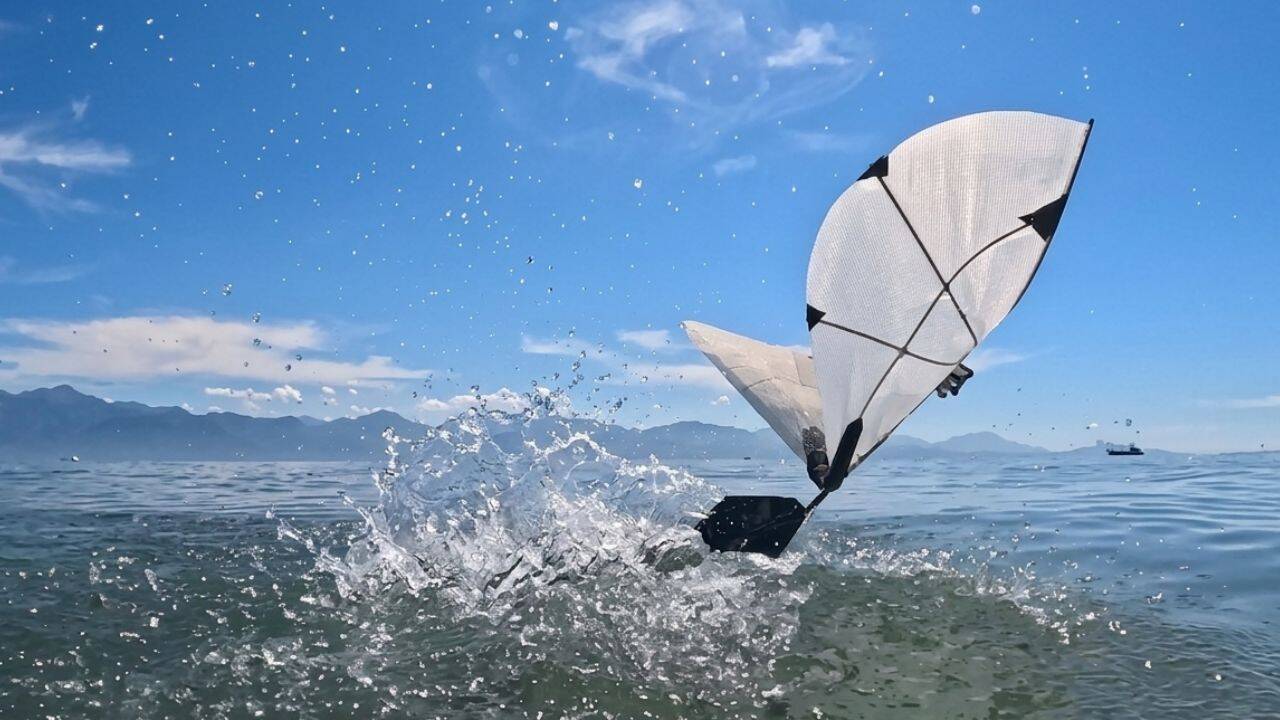
Engineering a drone that flies through the air is simple. Building a submersible that moves through deep water is equally straightforward. Try putting them together into a single machine and your design choices will instantly fight each other. Air requires lightweight structures and broad surfaces to generate lift. Water requires dense, compact, hydrodynamic profiles to withstand massive drag forces.
Most engineers try to solve this by slapping propellers onto an airplane frame or adding wings to a miniature submarine. The result is always a heavy, clumsy machine that does both jobs poorly.
A research team from MIT and EPFL in Switzerland threw out that entire design philosophy. Instead of adding more parts, they stripped the machine down to its absolute essentials. Their creation is the Flapping-Wing Aerial-Aquatic Vehicle, a 300-gram robot modeled directly after diving birds like the Atlantic puffin. It uses a single pair of flexible wings to fly, dive, swim, and launch back into the sky.
Why Copying a Puffin is Harder Than It Looks
Biologists have cataloged around 100 bird species that move fluidly between air and water. Puffins can fly fast across coastal coastlines and then plunge straight into the waves, swimming at speeds up to 3 meters per second to hunt fish. They make it look natural because biological systems adapt instantly. A puffin can fold its wings to reduce surface area underwater and use its powerful webbed feet to kick off the water surface during takeoff.
Robots don't have muscle memory or self-healing tissues. If you want a robot to fold its wings like a puffin, you have to add motorized joints, extra gears, and heavy electronic actuators. Every gram you add to make a robot a better submarine makes it a worse airplane. Weight kills flight efficiency.
The MIT team, led by Raphael Zufferey at the AURA Lab, bypassed the mechanical joints entirely. They relied on passive material properties instead of complex motorized systems. The wings are built from thin nylon membranes reinforced with stiff carbon fiber struts. When the robot flaps in the air, the struts keep the wing rigid enough to generate lift. When it hits the water, the intense fluid resistance forces the wings to passively bend backward by up to 90 degrees. This automatic deformation drastically reduces the wing's surface area, allowing the small onboard electric motor to keep flapping without burning out or snapping the framework.
The High Cost of Waterproofing Everything
The traditional approach to building a waterproof drone is to build a sealed, airtight hull around the electronics. That creates a huge problem underwater: buoyancy. A large, air-filled pocket wants to float. To force a highly buoyant drone to stay submerged, you have to run the motors constantly or add heavy ballast weights. Neither option works when your entire vehicle weighs less than a half-pound.
The engineers used a counterintuitive design rule. They built an open-body fuselage and let the water flood the entire frame.
Instead of protecting the robot with a heavy outer shell, they waterproofed every internal component individually. The battery, the central electric motor, the crankshaft, and the wiring are all encased in custom silicone coatings. When the robot dives, water flows freely through the skeleton. This achieves neutral buoyancy instantly. The robot doesn't waste energy fighting to stay submerged or struggling against sinking forces. It simply sits perfectly balanced in the water column.
Ditching the Feet and the Flaps
Taking off from the water surface is the most dangerous part of transmedium travel. Water surface tension acts like a physical barrier, trapping small objects. If you watch a duck or a loon take off, they don't just flap their wings; they sprint across the surface, paddling their webbed feet furiously to build up enough horizontal velocity to break free.
Adding mechanical legs to a 300-gram drone was out of the question. The team had to find a purely aerodynamic way to conquer surface tension.
They found the solution by adjusting the takeoff angle and the flapping frequency. During water trials, the robot pitches its motorized tail to force the entire body into a steep, 70-degree upward incline. The onboard motor then accelerates the flapping speed. While swimming underwater, the robot flaps its wings at a slow, deliberate pace of roughly 5 hertz to move at one meter per second. To exit the water, it ramps that speed up significantly, hitting frequencies near 10 to 11 hertz.
By combining the extreme 70-degree pitch with high-frequency wing beats, the robot generates a massive vertical thrust vector. It literally yanks itself straight out of the water in less than a second. The steep angle ensures that the flexible wingtips never smash against the water surface during the downstroke, a common failure point that flips or damages lesser drone designs.
Fluid Dynamics in Two Entirely Different Worlds
Air and water are governed by the same basic equations of fluid dynamics, but the scale is completely different. Water is roughly 800 to 1,000 times denser than air. To understand how the MIT vehicle manages both, look at its core operational metrics across both environments:
- Swimming Speed: 1 meter per second
- Swimming Flap Frequency: 5 hertz
- Flight Speed: 6 meters per second
- Flight Flap Frequency: 5 to 6 hertz
- Surface Escape Frequency: 10 to 11 hertz
- Maximum Flight Range: 4 miles per charge
- Maximum Swim Range: 1 mile per charge
The metrics show that the robot operates at almost identical frequencies for cruising in both air and water. The passive bending of the wings is what changes the fluid physics. By letting the material deform under water pressure, the team kept the electrical load on the battery stable across both mediums. You don't need a massive transmission or gear-shifting mechanism when your materials handle the physics for you.
To avoid water absorption, the nylon wing membranes are treated with specialized hydrophobic nanoparticles. Water beads up and flies off instantly during the transition phase. This keeps the robot from carrying dead weight back into the air.
Real World Tests in Lake Geneva
Lab testing in controlled water tanks is great for getting baseline data, but open environments introduce chaotic variables like wind, currents, and surface ripples. The research team took their prototypes to Lake Geneva in Switzerland to prove the design worked outside the lab.
They tested three distinct wingspans during these field trials: a compact 60-centimeter version, a medium 80-centimeter version, and a large 100-centimeter model.
The small wings were excellent for underwater maneuvering because they encountered less drag, but they struggled to create enough lift to support the robot during open-air flight. The large wings made flight incredibly stable but suffered severe structural stress underwater, bending too far and losing propulsion efficiency. The medium 80-centimeter configuration hit the sweet spot. It offered the exact balance of surface area and flexibility needed to transition reliably between both mediums without mechanical adjustments.
What This Means for Environmental Science
This isn't just an engineering exercise to show off clever mechanics. Traditional ocean monitoring relies on large research vessels, static buoys, or bulky autonomous underwater vehicles. These methods cost thousands of dollars per day and can't easily access shallow, dangerous, or remote coastal zones.
A fleet of lightweight, bio-inspired aerial-aquatic vehicles changes how we collect environmental data. Researchers can launch these drones from the shore or a small boat miles away from the target zone. The robot flies to a precise location, dives beneath the surface to gather water samples, tracks toxic algal blooms, or monitors marine life, and then flies straight back to base to dump the data.
The current prototype flies for nearly four miles or swims for a little over a mile on a single charge. The next immediate step for the AURA Lab team is adding functional data sensors to the payload and testing the system in rough coastal ocean surf, where heavy winds and breaking waves will push the passive flexible wing design to its absolute limits.