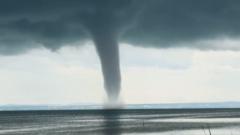
You probably think massive vortexes belong exclusively to the American Midwest or tropical oceans. You're wrong. On July 1, 2026, a monstrous waterspout tore right across Lake Constance near Lindau, Germany. It shocked onlookers. It stopped traffic. It looked like a scene straight out of a Hollywood disaster flick, spinning a massive column of water and cloud right into the sky.
The internet quickly flooded with short, shaky phone videos of the event. Most mainstream media outlets posted a thirty-second clip, muttered a few words about a "rare weather event," and moved on. But they missed the real story. This wasn't just a pretty visual for your social media feed. It was a atmospheric anomaly that broke the usual rules of European weather, and it signals a shift in how we need to view lake safety in a changing climate.
Understanding what happened out there on the water matters. If you own a boat, fish, or just vacation near major lakes, ignoring these phenomena is a mistake. Let's break down exactly what went down in southern Germany and why this terrifyingly beautiful vortex shouldn't have been there in the first place.
The Lake Constance Event Broken Down
It happened fast. Around midday on Wednesday, the sky over Lake Constance darkened significantly. Without warning, a spinning cloud stretched downward from the sky while a corresponding swirl of water whipped upward from the lake surface. They met in the middle. The result was a towering, perfectly defined waterspout that danced across the water for a solid five to ten minutes.
Local witnesses near Lindau described a roaring sound, similar to a distant freight train. The German Meteorological Agency, known as the DWD, tracks these events closely. They confirmed that while Germany gets two to three waterspouts a year, they almost never show up in early July.
That timing is the golden nugget of this entire event. Usually, these vortexes are autumn phenomena in Europe. Seeing one this size, this defined, right at the start of summer is bizarre. It requires a highly specific, volatile cocktail of atmospheric conditions that standard summer weather rarely provides.
The Weird Science Behind a Summer Waterspout
To understand why the Lindau waterspout was so weird, you have to look at the temperature differential. Waterspouts generally fall into two categories: tornadic and fair-weather.
Tornadic waterspouts are basically traditional tornadoes that happen to form over water. They start high up in a severe thunderstorm mesocyclone and breed chaos. Fair-weather waterspouts, despite the gentle name, are completely different animals. They form from the water surface up toward the clouds.
The Lake Constance event was a classic fair-weather waterspout that grew abnormally huge.
For these to form, you need warm water at the surface and a sudden, biting influx of cold air directly above it. This creates intense instability. Warm, moist air rushes upward rapidly, creating a vacuum. If there is even a slight horizontal wind shift near the water surface, that rising air starts to spin.
In Germany, this specific setup usually waits until September. By late autumn, the lakes have baked under the summer sun for months, holding onto immense heat. When the first true arctic air masses of autumn sweep across Europe, the temperature contrast is explosive.
July is a different story. In early July, European lakes are still warming up. The upper atmosphere is generally warm too. On July 1, however, an unseasonably cold pocket of air stalled directly over the warm alpine region. That extreme contrast triggered a massive cross-circulation. The lake basically breathed out a giant, spinning sigh of water vapor.
How a Waterspout Actually Forms Step by Step
People think a waterspout just drops from the sky like a rock. It doesn't. The process is incredibly systematic. Meteorologists divide the life cycle into five distinct phases, and the Lindau vortex checked every single box with textbook precision.
First comes the dark spot. A prominent, light-colored disk appears on the lake surface, encircled by a darker, shifting area of water. This is the hidden vortex making its first physical contact with the lake.
Second is the spiral pattern. Alternating bands of light and dark water begin to twist outward from that original spot. The spin is gaining speed.
Third is the spray ring. This is where things get dramatic. A dense, swirling ring of water spray—called a cascade—whips up from the lake surface. It looks like a miniature whirlpool flying into the air.
Fourth is the full funnel. The vortex stretches all the way to the overhead cloud base, becoming completely visible to the naked eye. This is the stage that caught everyone's attention in Germany. The spray vortex can easily climb several hundred feet into the air.
Fifth is the decay. The inflow of warm air slows down. The funnel weakens, thins, and snaps like a rubber band.
Lethal Myths You Need to Ignore
We need to talk about the danger. Because these phenomena look incredibly cool on video, people treat them like tourist attractions. They pull out their phones. They get closer. That thought process can kill you.
Myth 1: They Only Suck Up Water
Look closely at the Lindau video. It looks like a massive straw drinking from Lake Constance. It isn't. The actual column you see is mostly made of freshwater condensation caused by the extreme drop in pressure inside the vortex. The only actual lake water is the spray at the very bottom. Because it's cloud condensation, it moves with incredible speed and can shift direction instantly.
Myth 2: Fair-Weather Means Safe
This is a dangerous naming convention. Sure, a fair-weather waterspout won't flatten a brick house like an F5 tornado in Oklahoma. But it will absolutely capsize a sailboat, toss a jet ski, or drown a swimmer. The winds inside a large waterspout can easily exceed eighty miles per hour.
Think back to August 2024. A sudden waterspout struck the luxury yacht Bayesian off the coast of Sicily. That was a massive, high-end vessel. It sank within minutes, taking seven lives with it. If a waterspout can take down a superyacht, it will destroy your weekend fishing boat without blinking.
Surviving an Encounter on the Water
If you find yourself on a lake when a vortex starts assembling, you don't have time to look for a camera. You need to act.
First, watch the water, not just the clouds. If you see a rotating dark spot or a sudden patch of unexplained mist hovering over the lake, that's phase one. Don't wait for the full funnel to drop.
Second, never try to outrun it in a straight line. Waterspouts move in unpredictable paths dictated by localized wind currents. The smart move is to navigate at a ninety-degree angle away from its apparent path of motion.
Third, if you're trapped and cannot get away, drop your sails immediately if you're on a rig. Secure all loose gear. Put on your life jacket. Get below deck if your vessel allows it. If you're in an open boat, stay low in the center of the craft to keep the center of gravity as stable as possible.
The Next Steps for Lake Boaters
The Germany event is a stark reminder that nature doesn't care about the calendar. Weather patterns are getting weird. Seasonal lines are blurring.
Before you head out onto any major body of water this season, take these three concrete steps to protect yourself.
- Check the upper air profiles: Don't just look at the standard surface temperature on your phone app. Check local meteorological updates for warnings about cold air drops aloft. If the lake water is warm and a sudden cold front is moving in overhead, stay off the water.
- Know the ninety-degree rule: Memorize your escape angles. If a spout forms north of you and seems to be tracking south, don't just throttle backward. Head due east or due west immediately.
- Equip a marine radio: Cellular service can fail during sudden thermal storms. A dedicated VHF marine radio ensures you hear emergency weather broadcasts from local authorities the second a vortex is sighted.
Stop treating extreme weather videos like mere entertainment. The massive twister over Lake Constance was an incredible sight, but it was also a warning shot. Respect the water, watch the sky, and know when to stay on the dock.