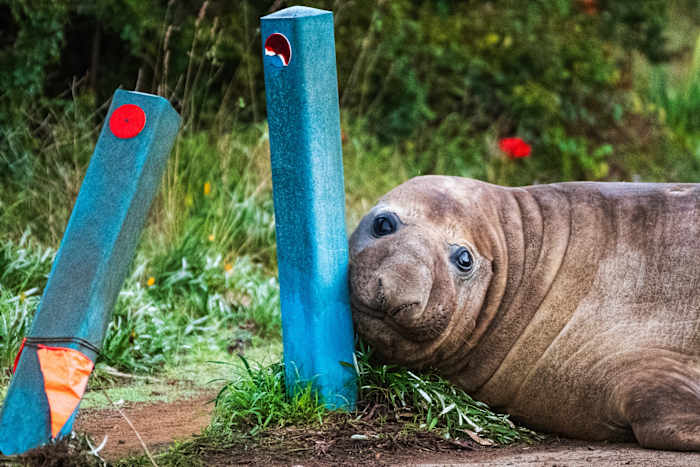
Neil the Seal does not care about your property values. He does not care about traffic laws, local infrastructure, or your desperate need for social media engagement. Weighing in at a massive 1,000 kilograms, this five-year-old southern elephant seal has once again hauled his blubbery body onto the beaches and suburban streets of southern Tasmania. He is smashing through barricades, flattening residential fences, picking fights with parked cars, and using orange traffic cones as personal chew toys.
To his 1.4 million TikTok followers, Neil is an anti-authoritarian icon. He is a local legend who stops traffic just by taking a nap in the middle of a public road. Independent Tasmanian Senator Jacqui Lambie even called him the only bloke in Tasmania who can stop traffic, ignore everyone, and still be loved for it.
But behind the viral videos and the lighthearted memes lies a terrifyingly stupid human behavior pattern that might get Neil killed.
Wildlife authorities are panicking because people are treating a massive apex predator like a giant, cuddly stuffed animal. Tourists and locals are routinely ignoring mandatory distance rules. Even worse, some people are literally carrying their human babies up to the seal to snap a photo for Instagram. This is an incredible display of public ignorance, and if it continues, it will end in a bloodbath or the forced euthanasia of a rare marine mammal.
The Dangerous Price of Internet Stardom
The problem isn't the seal. Neil is just doing what elephant seals do. He came ashore for his biannual haul-out, a six-week period where these animals rest, fast, and shed their fur after months of heavy feeding in the Southern Ocean. This is his 12th visit to the area. Because he was born on a southeast Tasmanian beach in October 2020, his internal biological programming tells him that this specific stretch of coast is home.
The real danger is the public's inability to comprehend the sheer scale and power of the animal in front of them.
Dr. Kris Carlyon, the section head for wildlife health at Tasmania's Department of Natural Resources and Environment, made the situation incredibly clear during a press conference in Hobart. He stated that the public is essentially at risk of loving Neil to death. It is a classic example of internet fame outgrowing what is safe or healthy for a wild animal.
When a video of a seal knocking over a bollard near a phone box hits 17 million views, it creates a dangerous feedback loop. People see the content, drive down to the coast, and try to replicate the interaction for their own channels. They treat a marine predator with massive teeth and crushing weight as a backdrop for a selfie.
Dr. Jane Younger, a seal expert and senior lecturer at the University of Tasmania, warns that Neil is already at a size where he is highly dangerous. Even if he isn't acting out of aggression, a single accidental movement from a 1,000-kilogram animal can crush human bones or kill a person instantly. They have massive jaws. They have sharp teeth. If a human gets bit, the injuries will be catastrophic.
Why Tasmania Is This Giant Predator's Chosen Playground
Most southern elephant seals live thousands of kilometers away in the subantarctic region, specifically on places like Macquarie Island and Heard Island. Neil's presence in Tasmania is a massive anomaly.
Experts believe Neil was born to a young, inexperienced mother who ventured too far north by mistake. Because elephant seals return to their place of birth to moult and rest, Neil keeps coming back to the suburbs of Hobart. He does not have a map. He does not know that his cousins are living on remote subantarctic islands. He thinks the local boat ramps and concrete sidewalks are his natural habitat.
Historically, Tasmania used to host massive colonies of elephant seals in the northwest. Human hunting wiped them out entirely in the early 1800s. While some conservationists view Neil’s regular return as a beautiful sign that the species could eventually repopulate their ancestral grounds, his solo status makes things incredibly complicated.
Neil is basically a lonely teenager. He is growing rapidly, but he has no other seals to interact with. When he smashes into a Toyota LandCruiser or wrestles with a plastic bollard, he isn't trying to be a criminal. He is play-fighting. He is testing his strength against inanimate objects because there are no other male seals around to teach him how to behave.
The scariest part is that Neil is nowhere near his full size. Right now, he is a one-ton juvenile. When he reaches full adulthood in a few years, he could easily tip the scales at 3,500 kilograms and stretch up to 4.5 meters in length. If he thinks a suburban street corner is his territory now, imagine the logistical nightmare when he weighs three times as much.
When Instagram Clout Meets a One Ton Carnivore
People are doing remarkably dumb things around this animal. Wildlife officers have documented onlookers trying to leave food out for him. This shows a complete lack of basic biological understanding. Elephant seals fast while they are on land. Neil does not want your fish, he does not want your leftovers, and trying to feed him only disrupts his natural life cycle.
The baby photo incidents are what truly pushed officials to issue their latest warnings. Approaching a wild carnivore while holding an infant is a level of risk-taking that defies common sense.
Dr. Carlyon pointed out that nobody would walk up to a wild polar bear or a bison in a national park to get a close-up photo. Yet, because seals have big eyes and look clumsy on land, people assume they are safe. This is a lethal optical illusion. On land, elephant seals can move surprisingly fast in short bursts when startled or annoyed. If you are standing between Neil and the ocean, you are in a high-risk zone.
Wildlife rangers, police officers, and security personnel are spending countless hours tracking Neil's movements and erecting temporary barriers to keep people away. But the public keeps pushing the boundaries. People are actively sharing his exact location online, creating instant tourist swarms in quiet residential neighborhoods. This has forced authorities to beg fans to stop identifying the specific towns Neil is visiting.
The Grim Reality of Wildlife Mismanagement
If the public refuses to back off, the ending to this story will not be happy. We have seen this exact script play out before on the global stage, and it always ends poorly for the animal.
Consider the tragic case of Freya the walrus in Norway back in 2022. Freya became a global internet sensation for sinking small boats and sunbathing on docks. Just like Neil, she drew massive crowds of onlookers who refused to follow safety guidelines. Despite dozens of warnings from officials, people kept crowding her, bringing children close, and throwing objects.
The Norwegian government ultimately decided that the public safety risk was unmanageable. They euthanized Freya. The animal paid the ultimate price because humans could not control their desire for a good social media photo.
Tasmanian authorities are explicitly bringing up Freya’s story because they want the public to understand the stakes. Euthanasia or forced relocation are being openly discussed as a last resort if the public cannot manage its own behavior. Relocating a one-ton seal is an incredibly dangerous, expensive, and stressful operation that puts both the animal and the handlers at risk. And because Neil is hardwired to return to his birthplace, he would likely just swim right back.
How to Actually Protect a Marine Icon
If you want to keep Neil safe, you have to follow the actual laws designed to protect him. This isn't optional advice. Native wildlife harassment carries massive legal penalties in Australia. Under current regulations, touching or disturbing native wildlife can result in fines of up to $16,000 and a maximum jail sentence of 12 months.
The guidelines are incredibly straightforward:
- Maintain a strict 20-meter distance from Neil at all times, even if he appears to be fast asleep on a sidewalk.
- Keep your dogs on a leash and at least 50 meters away from the seal. A dog encounter can trigger an aggressive defensive reaction from Neil or lead to severe injuries to your pet.
- Never block his path to the water. If he feels cornered or cut off from his escape route, his stress levels will skyrocket, making him unpredictable and highly dangerous.
- Stop geotagging his location. If you see him, enjoy the sight from a safe distance, but do not post his exact coordinates on TikTok or Instagram to fuel another crowd surge.
Dale Creamer, a resident of a town Neil recently visited, famously told reporters that it’s Neil’s world and we’re just living in it. That sentiment is nice, but right now, humans are making that world unlivable for him.
Back away from the seal. Put down the phone. Let him sleep in his puddle, crush his bollards, and finish his moult in peace. If you truly love Neil, leave him completely alone.